
The Universe Counts

When is the next meteor shower?

39d 23h 49m 32s

Time until the next peak of a major meteor shower (the Quadrantids, Perseids or Geminids)

The countdown above runs to the next peak of one of the year's three strongest meteor showers. The Geminids peak on 14 December 2026, the Quadrantids on 4 January 2027 and the Perseids on 13 August 2027. Smaller showers come in between, and a few stray meteors cross the sky on any clear night. To see a shower, find somewhere dark on the nights around its peak, give your eyes time to adjust, and look up, best after midnight. You need no telescope, only patience and a clear sky.

Time until the next peak of the Geminids meteor shower
39d 23h 49m 32s
Measured, with error
Time until the next peak of the Quadrantids meteor shower
60d 13h 14m 32s
Measured, with error
Time until the next peak of the Perseids meteor shower
281d 17h 49m 32s
Measured, with error
How much of the Moon's face is lit right now, as seen from Earth's centre
22 percent
Measured
updated just now

What is a shooting star?

What is a meteor?

A meteor, or shooting star, has nothing to do with stars. It is a speck of rock or dust from space, most no bigger than a grain of sand or a small pebble, hitting the top of our air at enormous speed. The grain heats up and vaporises, and the air along its path glows. That streak of light is the meteor.

Most meteors light up between 80 and 120 kilometres above the ground. That is about 11 times the height of Everest, yet the International Space Station flies about 4.3 times higher still.

Speed is what makes a grain so bright. Perseid meteors hit the air at 59 kilometres per second, and Geminids at 35. At that speed even a grain of sand carries enough energy to light up the sky for a moment.

Almost all of them burn up completely. A piece that survives and lands is called a meteorite, but the grains in a meteor shower almost never make it to the ground.

59 km/sSpeed at which Perseid meteors hit the top of the atmosphere

  1. About 62 times as fast as a rifle bullet leaving the barrel.
What causes a meteor shower?

Why showers come back on the same dates

Comets, and a few asteroids, shed dust as they swing round the Sun. Over many orbits the grains spread out along the comet's path into a long, thin stream. Where that stream crosses the Earth's orbit, the Earth drives through it at the same point every year, and so on the same dates. That is a meteor shower.

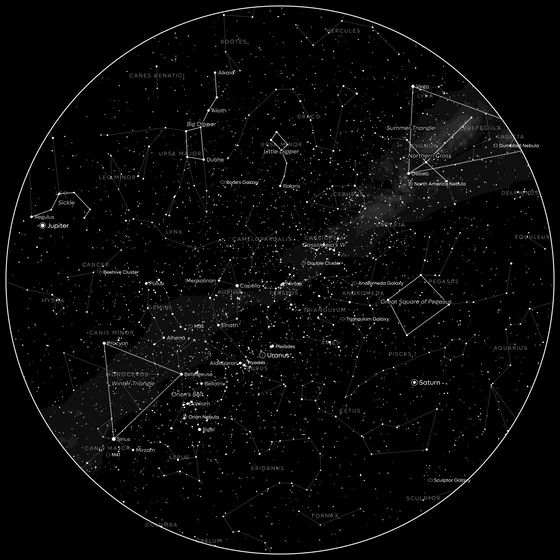
All the grains in a stream travel side by side, on parallel paths. Seen from the ground, their trails seem to spread out from one spot in the sky, the way railway lines seem to meet in the distance. That spot is called the radiant, and a shower is named after the constellation it sits in: the Perseids seem to come from Perseus, the Geminids from Gemini. You don't need to look at the radiant itself. Meteors can appear anywhere in the sky.

The peak moves by up to a day from one year to the next, because our calendar year doesn't fit the Earth's orbit exactly. So astronomers fix each peak by where the Earth is on its orbit, and the dates on this page are worked out that way.

Meteor shower calendar

The big showers of the year

Three showers stand out each year. The Quadrantids peak on 4 January 2027. Their dust comes from a small body called 2003 EH1, perhaps a worn-out comet, and their peak lasts only a few hours. The Perseids peak on 13 August 2027, on warm summer nights in the north. Their parent is the large comet Swift-Tuttle, last seen near the Sun in 1992. The Geminids peak on 14 December 2026, and come from an asteroid.

A shower's strength is given as its zenithal hourly rate: what one person would count in an hour under a perfect black sky, with the radiant straight overhead. For the Geminids it is 150, for the Perseids 100, and for the Quadrantids between 60 and 200, depending on the year. Real skies are never perfect. Under a dark country sky at the Geminids' peak, expect something like between 40 and 50 an hour, and from a town far fewer.

Smaller showers fill the gaps: the Lyrids in April; the Eta Aquariids in May, seen before dawn and best from the tropics and the south; the Orionids in October; the Leonids in November, famous for rare storms; and the Ursids just before Christmas. The Eta Aquariids and the Orionids are both made of dust from Halley's Comet.

150Zenithal hourly rate of the Geminids at their peak: meteors an hour one observer would see under a perfect sky with the radiant overhead

When is the Geminid meteor shower?

The Geminids and the rock that sheds

The Geminids are the most reliable shower of the year. They are active through the first three weeks of December and peak on 14 December 2026. The best nights are the ones either side of that moment. Unlike most showers, they are good in the evening too: from the Northern Hemisphere, Gemini rises around sunset, so meteors start early and are most plentiful after midnight. From the Southern Hemisphere the radiant rises only around midnight, so there are fewer.

Most showers come from comets. The Geminids come from 3200 Phaethon, a rocky asteroid a few kilometres across that swings closer to the Sun than Mercury ever does. Near the Sun it brightens and grows a short tail, which turns out to be glowing sodium gas, not dust. That is far too little to feed the shower, so astronomers think something broke a great deal of material off Phaethon a few thousand years ago. Each December the Earth drives through those pieces.

Geminid grains are denser than comet dust. They arrive more slowly than many shower meteors, and are often bright and yellowish.

35 km/sSpeed at which Geminid meteors hit the top of the atmosphere

  1. About 37 times as fast as a rifle bullet leaving the barrel.

How do you see a meteor shower?

How to watch, and what the Moon does

You need no telescope or binoculars; they show too small a patch of sky. Find the darkest place you can reach, with a wide view and no lights nearby. Lie back on a reclining chair or a sleeping bag, dress warmly, and look about halfway up. Give your eyes around half an hour in the dark, and keep your phone screen away. Then be patient: meteors come unevenly, with quiet spells and then several close together.

Most showers are best after midnight, when the radiant is higher and your side of the Earth faces forward along its orbit.

The Moon matters as much as the weather. Bright moonlight washes out the fainter meteors, so a shower near full Moon can lose a large part of its show, while one near new Moon gives the most. What counts is whether the Moon is up while you watch: a crescent sets early in the evening or rises only just before dawn. Right now the Moon is 22 per cent lit, and the next new Moon is on 9 November 2026. Check the Moon's phase for the peak night before you plan.

Light pollution takes its share too. From a city centre you may see only the brightest few.

What is a fireball?

Fireballs

Now and then a meteor outshines the planet Venus. That is a fireball. It comes from a larger piece than an ordinary meteor, it lasts longer, and it can leave a glowing trail that hangs in the sky for a few seconds. Thousands of fireballs blaze somewhere in Earth's sky every day, but most happen over the oceans, in empty places or in daylight, so few are seen.

Some showers are known for them: the Perseids, the Quadrantids and the Geminids all bring their share. But a fireball can appear on any night, in any part of the sky.

The biggest are watched from above. US government sensors record bright fireballs around the world, and NASA's Center for Near-Earth Object Studies publishes them, usually some weeks later. Weather satellites with lightning cameras pick them up too.

If you see one, note the time, which way it went, how bright it was and how long it lasted. The American Meteor Society and the International Meteor Organization collect reports from the public, and many reports of one fireball together can reveal its path through the sky.

Each streak is a grain of a comet or an asteroid, ending its long path round the Sun in a moment of light above you. Who would you like beside you when the next one falls?

Questions people ask

What is the best time to see the Geminids?

On the nights either side of the peak, 14 December 2026. From the Northern Hemisphere they begin in the evening, as Gemini rises, and are most plentiful after midnight, when the radiant is highest. From the Southern Hemisphere, wait until after midnight.

Which direction should I look for the Geminids?

Any direction. The meteors seem to come from the constellation Gemini, the Twins, but they streak across every part of the sky. Look about halfway up, at the darkest part of your sky and away from the Moon.

Where can you see the Geminids?

From almost anywhere on Earth, but best from the middle and northern latitudes, where the radiant is up from the evening on. From the Southern Hemisphere you see fewer, and only after midnight.

How rare is the Geminid meteor shower?

Not rare at all: it comes back every December. It is young, though. The Geminids first appeared in the mid-1800s, with far fewer meteors than today, and have grown into one of the strongest showers of the year.

Is there a meteor shower tonight?

Several meteors an hour can be seen on most clear, dark nights, even with no shower. A shower is active for days or weeks around its peak, so the countdowns above tell you whether a big one is close.

How do we know?

Every number on this page has a source

Show the 16 numbers and their sources
FactValueCertaintySourceAs of
Geminid meteors one person can expect to see in an hour at the peak, under a dark sky45EstimatedNASA Science
4 Nov 2026
Height above the ground at which most meteors glow100 kmEstimatedAmerican Meteor Society
4 Nov 2026
Height of Mount Everest above sea level8,848.86 mMeasuredSurvey Department, Government of Nepal
8 Dec 2020
How much of the Moon's face is lit right now, as seen from Earth's centre22 percentMeasuredNASA JPL
4 Nov 2026, 14:10 UTC
Speed at which Geminid meteors hit the top of the atmosphere35 km/sMeasured, with errorInternational Meteor Organization
NASA Science
4 Nov 2026
Speed at which Perseid meteors hit the top of the atmosphere59 km/sMeasured, with errorInternational Meteor Organization
NASA Science
4 Nov 2026
The International Space Station's mean height above Earth426 kmMeasuredCelesTrak
NASA
18 Oct 2026
Time until the next new Moon4d 16h 51m 32sMeasuredUS Naval Observatory
4 Nov 2026
Time until the next peak of a major meteor shower (the Quadrantids, Perseids or Geminids)39d 23h 49m 32sMeasured, with errorInternational Meteor Organization
International Meteor Organization
NASA JPL
4 Nov 2026
Time until the next peak of the Geminids meteor shower39d 23h 49m 32sMeasured, with errorInternational Meteor Organization
International Meteor Organization
NASA JPL
4 Nov 2026
Time until the next peak of the Perseids meteor shower281d 17h 49m 32sMeasured, with errorInternational Meteor Organization
NASA JPL
4 Nov 2026
Time until the next peak of the Quadrantids meteor shower60d 13h 14m 32sMeasured, with errorInternational Meteor Organization
NASA JPL
4 Nov 2026
Typical muzzle velocity of a rifle bullet945 m/sEstimatedHeadquarters, Department of the Army
27 Oct 2026
Zenithal hourly rate of the Geminids at their peak: meteors an hour one observer would see under a perfect sky with the radiant overhead150EstimatedInternational Meteor Organization
NASA Science
4 Nov 2026
Zenithal hourly rate of the Perseids at their peak: meteors an hour one observer would see under a perfect sky with the radiant overhead100EstimatedInternational Meteor Organization
NASA Science
4 Nov 2026
Zenithal hourly rate of the Quadrantids at their peak: meteors an hour one observer would see under a perfect sky with the radiant overhead80EstimatedInternational Meteor Organization
NASA Science
4 Nov 2026