
The Universe Counts

Where is the International Space Station right now?

-15,920

kilometres · The International Space Station's height above Earth at a stated moment

The International Space Station is in low Earth orbit. At 00:00 UTC on 11 November 2026, official NASA trajectory data placed it -15,920 kilometres above Earth's surface, moving at 7.66 kilometres per second relative to Earth. That height is the value at that moment, not the daily mean. People have lived aboard without a break since 2 November 2000. You can see it with your own eyes through NASA's Spot the Station; it is not drawn on this site's star map.

Right now

The International Space Station's mean height above Earth
425 km
Measured
The International Space Station's orbital speed
7.66 km/s
Measured
Orbits of Earth completed by the International Space Station
159,630
Measured, with error
Earth orbits the International Space Station completes in 24 hours
16
Measured
Time since people have lived continuously aboard the International Space Station
26y 20d 1h
Measured

Official trajectory, not a guessed pin

Where it is, at a stated moment

The station moves so quickly that a latitude and longitude copied from a tracker is wrong within minutes. The number above is the height above Earth's surface — not the distance from Earth's centre — at 00:00 UTC on 11 November 2026, from NASA's official Orbit Ephemeris Message, produced by the ISS Trajectory Operations and Planning Officer at Johnson Space Center.

That file was created on 9 November 2026 at 15:56 UTC and is usable through 24 November 2026. NASA updates the predicted trajectory about three times a week, because drag at this height makes a projection go stale. JPL Horizons target `-125544` is a real ID, revised on 10 November 2026, but Horizons itself says the trajectory is TLE-based and of low accuracy more than a few days past that revision. At the same instant, Horizons and a CelesTrak element set agreed with the NASA file to a fraction of a kilometre. The official NASA ephemeris is the better source for a live feed.
Instantaneous and mean

How high, and why that height changes

The orbit is slightly elliptical, and Earth is not a perfect sphere, so the height above the surface swings by tens of kilometres on each pass. On 11 November 2026 the NASA ephemeris ranged from 414 to 438 kilometres. The mean for that day was 425 kilometres. NASA's stated operating range is the span already attached to that mean-height fact. The height falls slowly through drag and jumps up when the station is reboosted.

The number at the top of the page is the height at one instant. The mean, here, is the one to use when you want a typical figure for the day. A comparison that makes that mean height feel close is attached to the fact, not repeated in this paragraph.

425 kmThe International Space Station's mean height above Earth

  1. About 48 times the height of Everest.

Relative to Earth

How fast, and how often it circles

The station's orbital speed is 7.66 kilometres per second relative to Earth — relative to Earth's centre, not to the turning ground. NASA also says it makes 16 orbits of Earth in 24 hours, travelling through as many sunrises and sunsets. The inclination is 51.6 degrees, so it does not pass overhead everywhere.

The orbit count since the first module, Zarya, launched on 20 November 1998, is a live tally: 159,630. It keeps climbing while you read. Those 16 sunrises a day are the moving number the crew sees, and the orbit count is the one that ticks on while the page is open. It is not a speed record, and it is not Parker Solar Probe's perihelion speed relative to the Sun; those are different frames.

NASA Spot the Station

How to see it with your own eyes

The station looks like a bright, steady point of light, not a flashing aircraft. NASA's Spot the Station service, and the official app, tell you when a visible pass is due over your location. The orbit's inclination means people far north or south of that track never see it pass overhead, though they may still see it lower in the sky.

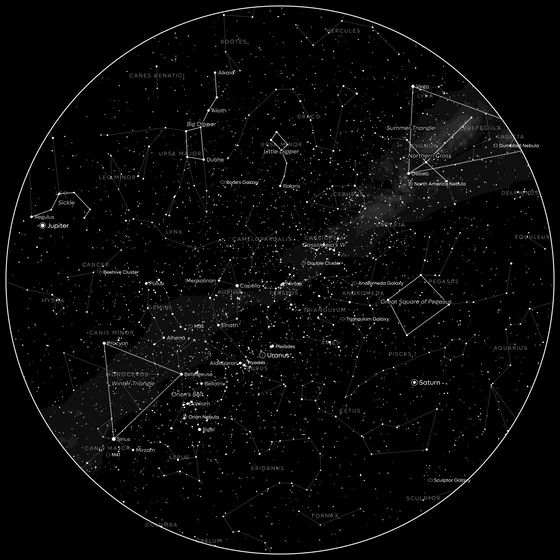
This site's star map does not draw the station. If you want to see it, use Spot the Station, not that map. A pass lasts only a few minutes, and cloud or city lights can hide it, so the official predictions are the place to start.

Who is aboard is a different question, answered on the people in space page.

Size, occupation, and the end of the mission

A house that has been lived in since 2000

The station is 109 metres end-to-end, one yard shy of an American football field including the end zones, according to NASA's facts page. Crews have lived aboard without a break since 2 November 2000, when Expedition 1 arrived.

NASA has committed to operate the station through 2030, and its deorbit-vehicle announcement describes a controlled re-entry after the end of operational life in 2030. ESA's member states and, in NASA's frequently asked questions, Russia are also described as planning through 2030. That is not a firm day, so this page does not start a countdown. It says about 2030.

This research did not find a current official cost range on the NASA facts, FAQ, reference or transition pages loaded on 11 November 2026, and it does not invent one.

A bright point will slide across an evening sky tonight, somewhere on Earth. If it is the station, someone is living up there. What would you look for, if you stepped outside to see it?

Questions people ask

Where is the ISS right now?

In low Earth orbit. At 00:00 UTC on 11 November 2026 it was -15,920 kilometres above Earth's surface, from NASA's official ephemeris. The position changes by thousands of kilometres in minutes, so a copied map pin goes stale almost at once.

How high is the International Space Station?

-15,920 kilometres above Earth's surface at that dated instant. The mean for 11 November 2026 was 425 kilometres. Both are heights above the surface, not distances from Earth's centre.

How fast does the ISS travel?

7.66 kilometres per second relative to Earth. That is not a speed relative to the Sun, and it is not a claim that the station is the fastest spacecraft.

When can I see the ISS?

Use NASA's Spot the Station service for a visible pass over your location. It looks bright and steady, without flashing lights. It is not shown on this site's star map.

How long have people lived on the ISS?

Without a break since 2 November 2000.

When will the ISS come down?

NASA has committed to operate through 2030 and to deorbit the station after that operational life, in a controlled way. There is no firm day in the official pages loaded for this research, so there is no countdown here.

How do we know?

Every number on this page has a source

Show the 16 numbers and their sources
FactValueCertaintySourceAs of
Earth orbits the International Space Station completes in 24 hours16MeasuredNASA
11 Nov 2026
End-to-end length of the International Space Station109 mMeasuredNASA
11 Nov 2026
Height of Mount Everest above sea level8,848.86 mMeasuredSurvey Department, Government of Nepal
8 Dec 2020
Highest ISS height above Earth on 11 November 2026438 kmMeasuredNASA JSC TOPO
11 Nov 2026
Inclination of the International Space Station's orbit51.6 degreesMeasuredNASA
11 Nov 2026
James Webb Space Telescope's distance from Earth1,690,982 kmMeasuredNASA JPL
22 Nov 2026
Juno's distance from Earth771,476,703 kmMeasuredNASA JPL
NASA
22 Nov 2026
Lowest ISS height above Earth on 11 November 2026414 kmMeasuredNASA JSC TOPO
11 Nov 2026
New Horizons' distance from Earth9,990,132,586 kmMeasuredNASA JPL
22 Nov 2026
Orbits of Earth completed by the International Space Station159,630Measured, with errorCelesTrak
NASA
18 Oct 2026
The International Space Station's height above Earth at a stated moment-15,920 kmMeasuredNASA JSC TOPO
NASA
11 Nov 2026
The International Space Station's mean height above Earth425 kmMeasuredCelesTrak
NASA JSC TOPO
NASA
11 Nov 2026
The International Space Station's orbital speed7.66 km/sMeasuredCelesTrak
NASA
27 Oct 2026
Time since people have lived continuously aboard the International Space Station26y 20d 1hMeasuredNASA
NASA
2 Nov 2000
Voyager 1's distance from Earth25,910,875,775 kmMeasuredNASA JPL
NASA JPL
22 Nov 2026
Voyager 2's distance from Earth21,696,623,890 kmMeasuredNASA JPL
22 Nov 2026