
The Universe Counts

When did humans last walk on the Moon?

53y 342d 8h

Time since the last people left the Moon: Apollo 17's lunar module lifting off

It has been 19,701 days since the last people left the Moon. Eugene Cernan and Harrison Schmitt lifted off in Apollo 17's lunar module on 14 December 1972, at 22:54 UTC, when its ascent engine fired. Their last moonwalk had ended earlier that day. 12 people have walked on the Moon, all between 1969 and 1972, over 6 landings.

Time since Neil Armstrong first stepped onto the Moon (Apollo 11)
57y 124d 4h
Measured, with error
Number of people who have walked on the Moon
12
Measured
Number of people who flew to the Moon and back on Apollo
24
Measured
Mass of Moon rock and soil Apollo brought back
382 kg
Measured

What Apollo was

A programme to reach the Moon

Apollo was NASA's programme to take people to the Moon and bring them home. 9 flights took crews there. Some, like Apollo 8 and Apollo 13, did not land. Others put a lunar module on the surface while one crew member stayed in orbit.

Those flights carried 24 people, not more, because 3 of them flew twice. Of the 24, only 12 walked on the surface. The rest circled the Moon and came home.

"Flew to the Moon" counts people who travelled to the Moon and back on those flights, including the ones who never landed. The 4 astronauts of Artemis II, in 2026, are counted on their own.
The first step

One small step

Neil Armstrong, the commander of Apollo 11, set his boot on the Moon at 02:56 UTC on 21 July 1969. It was still the evening of 20 July in the United States. The step is now 20,943 days ago.

Published timings of the step differ by a few seconds, so the second is not firm. The moment matters because it is where the distance changes. Before it, the Moon was a place we watched. After it, the Moon was a place a person had been.

Armstrong and Buzz Aldrin spent hours on the surface and returned to orbit, where Michael Collins waited. Then the lunar module left, and the Moon was empty again.

The landings

Six landings and a near miss

Between July 1969 and December 1972, 6 landings put people on the Moon: Apollo 11, 12, 14, 15, 16 and 17. Apollo 13 was meant to be the third. An oxygen tank in the service module exploded on the way, which left the fuel cells without oxygen to make power. The landing was abandoned, and the crew returned to Earth safely.

The later landings reached farther. On the last three missions the crews drove a lunar rover, which let them go places that walking would not. On Apollo 17, Cernan and Schmitt lived on the surface for days, in the Taurus-Littrow valley, and drove the rover among its mountains and craters.

NASA calls Cernan the last human to leave footprints on the lunar surface.

The Moon rock

What they brought back

The astronauts returned 2,196 documented samples of rock and soil, 382 kilograms of it in all. Apollo 17, the last mission, returned the most.

In general, the largest part of each sample is kept for future study, though some important samples are nearly used up. Some are on public display. Scientists are still learning from rock collected half a century ago.

382 kgMass of Moon rock and soil Apollo brought back

  1. About 6.2 times the mass of an adult.

Why nobody has gone back

A long wait

There is no single reason for the gap, and we do not claim one. Apollo was a national effort built around one rocket, the Saturn V, and each of those rockets flew once. The last Saturn V flew in May 1973, to launch the Skylab space station.

For decades the Saturn V remained the only rocket that had carried people beyond low Earth orbit. That ended in April 2026, when NASA's Space Launch System sent Artemis II around the Moon. The gap between the last people on the Moon and the next ones is still open.

What comes next

Back to the Moon

In April 2026, 4 astronauts flew around the Moon on Artemis II, the first crew to fly to the Moon since Apollo. They did not land. NASA's plan, given on 23 October 2026, is an Artemis III test in Earth orbit in 2027, and an Artemis IV landing in 2028. The plan names the lunar South Pole as the place.

SpaceX's Starship is one of two landers NASA is working on. In the plan, it refuels in Earth orbit, meets Orion and carries it towards the Moon. These are plans, with the dates their makers gave, and plans move.

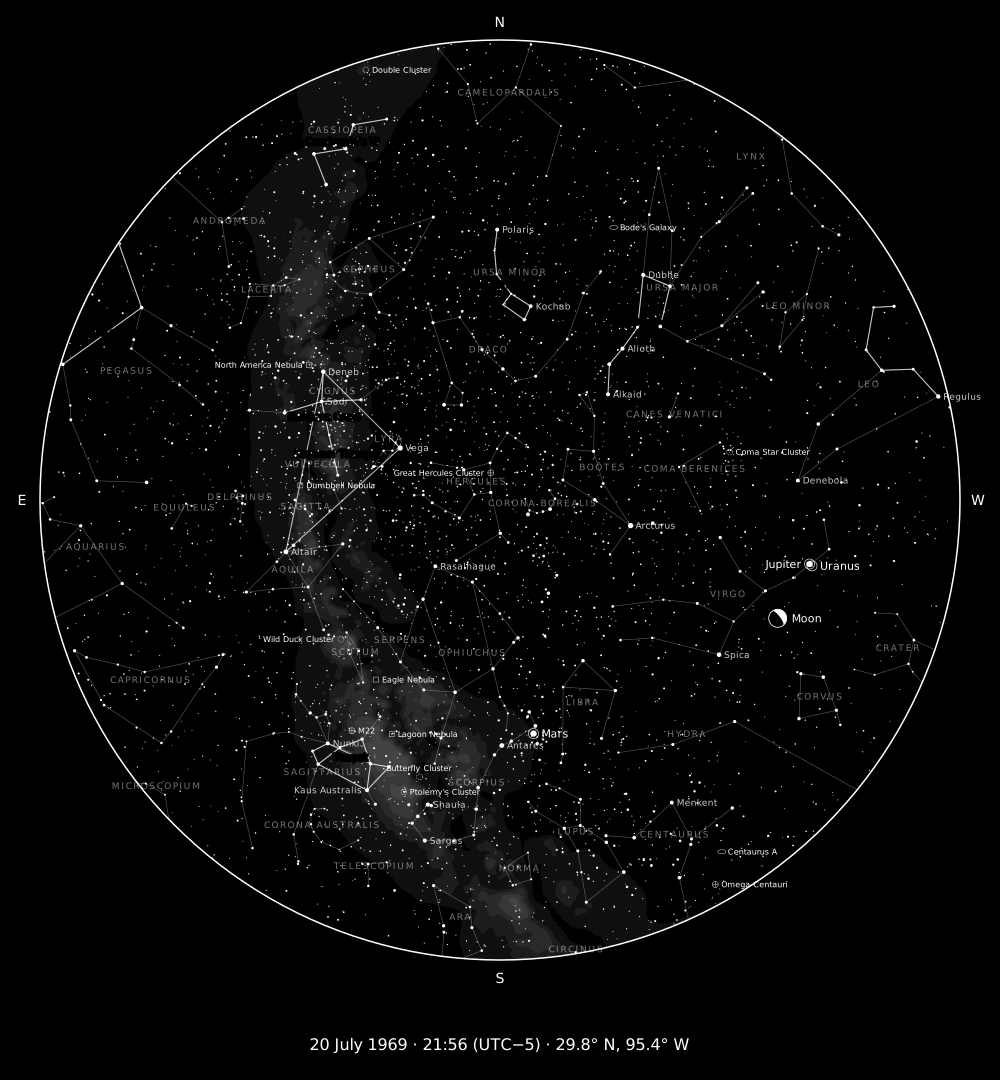
Star map of the sky from Houston

Only what is above your horizon is drawn.

  • Planet
  • Sun
  • Moon, with its phase
  • Star: the bigger, the brighter
  • Constellation
  • Familiar pattern
  • Milky Way
  • Galaxy
  • Nebula
  • Star cluster
  • Globular cluster

From Houston at 21:56 (UTC−5) on 20 July 1969: the Moon is 36% lit, in the west-south-west. Mars, Jupiter and Uranus are up: Mars in the south, Jupiter in the west-south-west, Uranus in the west-south-west. Mercury, Venus and Saturn are below the horizon. The brightest stars up are Arcturus (its light left 36.7 years ago), Vega (its light left 25.0 years ago) and Altair (its light left 16.7 years ago).

The footprints of the last two people to walk there lie in dust on a world with no air to blow them away. Who do you hope will make the next ones?

Questions people ask

When did humans last walk on the Moon?

On 14 December 1972, when Apollo 17's crew left the surface. The lift-off is counted from the moment the ascent engine fired.

How many people have walked on the Moon?

12 people, on 6 landings between 1969 and 1972. All of them were Apollo astronauts.

How many people have flown to the Moon?

24 people flew there and back on Apollo's 9 flights, because 3 flew twice. 4 more flew around it on Artemis II in April 2026.

How many Apollo missions landed on the Moon?

6: Apollo 11, 12, 14, 15, 16 and 17. Apollo 13 was meant to land and could not.

Who was the last person on the Moon?

Eugene Cernan, commander of Apollo 17, was the last to leave footprints on the lunar surface, according to NASA.

How much Moon rock did Apollo bring back?

382 kilograms, in 2,196 documented samples.

How do we know?

Every number on this page has a source

Show the 11 numbers and their sources
FactValueCertaintySourceAs of
Average body mass of an adult human, worldwide, in 200562 kgMeasured, with errorBMC Public Health (Walpole et al.)
31 Dec 2005
Mass of Moon rock and soil Apollo brought back382 kgMeasuredNASA Johnson Space Center Astromaterials Research and Exploration Science
NASA
15 Nov 2026
Number of Apollo crewed landings on the Moon6MeasuredNASA
NASA
15 Nov 2026
Number of Apollo flights that carried people to the Moon and back9MeasuredNASA Johnson Space Center Astromaterials Research and Exploration Science
15 Nov 2026
Number of astronauts who flew to the Moon twice on Apollo3MeasuredNASA Johnson Space Center Astromaterials Research and Exploration Science
15 Nov 2026
Number of documented lunar samples Apollo brought back2,196MeasuredNASA Johnson Space Center Astromaterials Research and Exploration Science
15 Nov 2026
Number of people who flew around the Moon on Artemis II4MeasuredNASA
15 Nov 2026
Number of people who flew to the Moon and back on Apollo24MeasuredNASA Johnson Space Center Astromaterials Research and Exploration Science
15 Nov 2026
Number of people who have walked on the Moon12MeasuredNASA
NASA Johnson Space Center Astromaterials Research and Exploration Science
15 Nov 2026
Time since Neil Armstrong first stepped onto the Moon (Apollo 11)57y 124d 4hMeasured, with errorNASA (Apollo Lunar Surface Journal)
15 Nov 2026
Time since the last people left the Moon: Apollo 17's lunar module lifting off53y 342d 8hMeasuredNASA (Apollo 17 Mission Report, JSC-07904; scan hosted by the Apollo Lunar Surface Journal)
15 Nov 2026