
The Universe Counts

What is the nearest star to Earth?

4.2465

light-years · Distance to Proxima Centauri

The nearest star is the Sun. After the Sun, the nearest is Proxima Centauri, the smallest of the three stars in the Alpha Centauri system. Its light takes 4.2465 years to reach us. The two the eye can see as one bright star are Rigil Kentaurus and Toliman, in the southern sky only.

Right now

Voyager 1's distance from the Sun
25,795,121,185 km
Measured
Live · as of 22 Nov 2026
Voyager 1's speed relative to the Sun
16.92 km/s
Measured
Confirmed exoplanets in the NASA Exoplanet Archive
6,473
Measured
updated 7 h ago

What is a star?

What a star is, and why the nearest neighbour is still so far

A star is a ball of hot gas, heavy enough to shine by its own light. The Sun is a star. It looks so large only because we live beside it.

The next stars are already far away. After the Sun, the nearest is Proxima Centauri, 4.2465 light-years from us. A light-year is the distance light travels in one year: about 9.5 trillion kilometres. Proxima is the smallest of three stars in one system, Alpha Centauri. It holds only 0.12 times the mass of the Sun, and is about 200,000 kilometres across, against the Sun's about 1.4 million kilometres.

The two brighter companions, Rigil Kentaurus and Toliman, sit a little farther out, at 4.34 light-years. That is still the nearest star system to the Sun. The scale under the answer runs from the Sun out to Proxima, with Voyager 1 shown live. It is the clearest way to see how empty the space between us is.
A family of three

The three stars, and how they move around each other

The International Astronomical Union names the three stars Rigil Kentaurus, Toliman and Proxima Centauri. Rigil Kentaurus is a little heavier than the Sun, at 1.1 times the Sun's mass, and a little wider. Toliman is a little lighter and smaller. They circle each other once every 79.762 years.

To the unaided eye they look like one bright star. Astronomers measure brightness in magnitudes, and the scale runs backwards: the lower the number, the brighter the star. Rigil Kentaurus has magnitude -0.01. Toliman has magnitude 1.35. Proxima, far fainter, is magnitude 11.01. It takes about 510,000 years to go around the pair, on a much wider path.

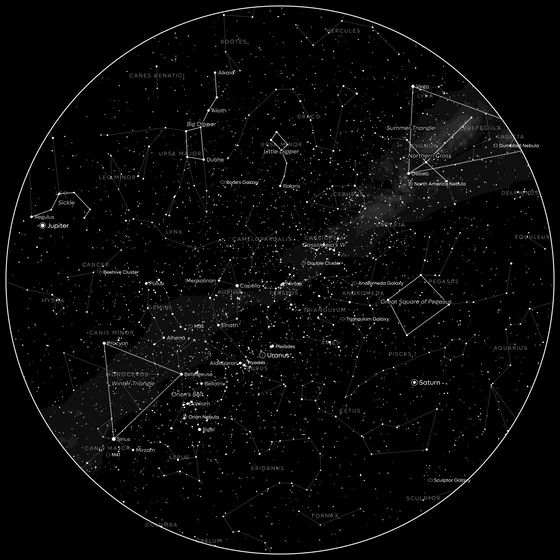
The bright pair can be seen from the southern sky, and from low northern latitudes south of about 29.2 degrees north. From most of Europe and the northern United States it never rises. Proxima itself is far fainter than the unaided eye can reach, even in a dark sky of about magnitude 6.5. You need a telescope to see it.

79.762 yearsOrbital period of Rigil Kentaurus and Toliman around each other

Two confirmed worlds

Proxima's planets, and what is actually known

The NASA Exoplanet Archive's live count of confirmed planets around other stars now stands at 6,473. Two of them belong to Proxima Centauri. Both are listed as confirmed. A third companion, sometimes called Proxima c, is not on that confirmed list.

Proxima b was found in 2016. It takes 11.185 days to go once around the star, at a distance of 0.04848 astronomical units. Its minimum mass is 1.055 times the mass of Earth. The true mass could be higher, because the tilt of its orbit has not been measured.

Proxima d is smaller and closer. Its minimum mass is 0.260 times the mass of Earth, its year is 5.123 days, and it orbits at 0.02881 astronomical units. It was confirmed in 2025.

Whether Proxima b could hold liquid water is not known. It sits at a distance where, around a quiet star, water might stay liquid. Proxima is a red dwarf that flares, and no telescope has yet shown that the planet has an atmosphere. Those flares may have stripped one away.

1.055 ratioMinimum mass of Proxima Centauri b (M sin i)

A nearby star's tiny shift

How the distance is measured

We measure these distances by parallax. As Earth goes around the Sun, a nearby star appears to shift slightly against far more distant stars. The size of that shift, together with the width of Earth's orbit, gives the distance. The closer the star, the larger the shift. Even for our nearest neighbours the shift is tiny, which is why the measurement needs a careful space telescope or a precise orbit.

The figure for Proxima comes from the European Space Agency's Gaia telescope. The bright pair is too bright, and too close together on the sky, for Gaia's standard processing. Their distance comes instead from the orbit they share, the same work that gives the period of Rigil Kentaurus and Toliman.

After the Alpha Centauri system, the next nearest star is Barnard's Star, at 5.9629 light-years. The three Alpha Centauri stars will remain our nearest neighbours on any human timescale. Brighter stars such as Sirius lie farther away: Sirius is 8.6 light-years from us.

5.9629 lyDistance to Barnard's Star

A voyage, only as a comparison

How long it would take to get there

Light covers the gap in 4.2465 years. That is what a light-year means. It is also how old the light is when it arrives: the starlight you see tonight has been travelling for years, or much longer.

At the present speed of Voyager 1, 16.92 kilometres per second, the same crossing would take about 75,000 years. That is a hypothetical travel time at the spacecraft's current speed, not a journey it is making. Voyager 1 is not heading toward Alpha Centauri. It is aimed toward the constellation Ophiuchus. In the year 40,272 it will come within 1.7 light-years of a different star in Ursa Minor, called AC+79 3888.

A proposed plan, Breakthrough Starshot, would try to send a very small craft across in about 20 years from launch. It would be driven by a laser and a sail. It is a plan, not a scheduled mission, and hard engineering problems remain.

16.92 km/sVoyager 1's speed relative to the Sun

The light leaving Proxima tonight will reach Earth 4.2465 years from now. Where will we have got to by then?

Questions people ask

Which star is closest to Earth?

The nearest star is the Sun. After the Sun, the nearest is Proxima Centauri, 4.2465 light-years away, the smallest of the three stars in the Alpha Centauri system.

Can we see Alpha Centauri from Earth?

Yes, but only the bright pair, and only from the southern sky or from low northern latitudes, south of about 29.2 degrees north. From most of Europe and the northern United States the pair never rises. The two stars, Rigil Kentaurus and Toliman, look like one. Proxima itself is too faint for the unaided eye; you need a telescope.

Why can't we go to Alpha Centauri?

The distance is the barrier. Light itself takes 4.2465 years to cross it. A craft at Voyager 1's present speed would need tens of thousands of years, and Voyager 1 is not heading there. Breakthrough Starshot is a proposed plan to cross in about 20 years from launch. It is not a scheduled mission.

What are the 10 closest stars to Earth?

After the Sun comes Proxima Centauri, then the bright pair Rigil Kentaurus and Toliman at 4.34 light-years, then Barnard's Star at 5.9629 light-years. This page is about our nearest neighbours, not a catalogue of the ten closest.

Could Alpha Centauri have a habitable planet?

Two planets around Proxima are confirmed: Proxima b and the smaller, closer Proxima d. Proxima b orbits in a region where, around a quieter star, liquid water might be possible. Whether it is habitable is not known. The star flares, and an atmosphere has not been shown. No source we used supports a figure such as a "99.7% chance of life".

How long would it take to get to Alpha Centauri?

Light would take 4.2465 years. A ship travelling at Voyager 1's present speed would take about 75,000 years. That comparison is hypothetical only. Voyager 1 is heading toward Ophiuchus, not toward this system. The Breakthrough Starshot plan speaks of about 20 years from launch, as a plan, not a flight on the calendar.

How do we know?

Every number on this page has a source

Show the 35 numbers and their sources
FactValueCertaintySourceAs of
Apparent visual magnitude of Proxima Centauri11.01 magMeasured, with errorIAU Working Group on Star Names
11 Nov 2026
Apparent visual magnitude of Rigil Kentaurus (Alpha Centauri A)-0.01 magMeasured, with errorIAU Working Group on Star Names
11 Nov 2026
Apparent visual magnitude of Toliman (Alpha Centauri B)1.35 magMeasured, with errorIAU Working Group on Star Names
11 Nov 2026
Breakthrough Starshot planned travel time to Alpha Centauri, from launch20 yearsEstimatedBreakthrough Initiatives
11 Nov 2026
Closest future approach of Voyager 1 to the star AC+79 3888 (Gliese 445)1.7 lyEstimatedNASA Science
11 Nov 2026
Confirmed exoplanets in the NASA Exoplanet Archive6,473MeasuredNASA Exoplanet Science Institute (Caltech/IPAC)
NASA Exoplanet Science Institute (Caltech/IPAC)
NASA
NASA
22 Nov 2026, 06:00 UTC
Diameter of Proxima Centauri196,200 kmMeasured, with errorAstronomy & Astrophysics (arXiv version)
NASA Exoplanet Archive
11 Nov 2026
Diameter of Rigil Kentaurus (Alpha Centauri A)1.7 million kmMeasured, with errorThe Astronomical Journal (arXiv version)
11 Nov 2026
Distance to Barnard's Star5.9629 lyMeasured, with errorESA / AIP
ESA
Astronomy & Astrophysics
ESA
1 Jan 2016
Distance to Proxima Centauri4.2465 lyMeasured, with errorESA
Astronomy & Astrophysics
ESA
1 Jan 2016
Distance to Rigil Kentaurus (α Centauri A)4.34 lyMeasured, with errorCDS / SIMBAD
The Astronomical Journal (arXiv version)
CDS / SIMBAD
31 Oct 2026
Distance to Sirius8.6 lyMeasured, with errorCDS / SIMBAD
Astronomy & Astrophysics
2 Apr 1991
Earth's average distance from the Sun1.0000 AUMeasuredNASA NSSDCA
1 Jan 2000
Earth's diameter at the equator12,756 kmMeasuredNASA NSSDCA
27 Oct 2026
Faintest star the eye can see in a perfectly dark sky (naked-eye limiting magnitude)6.5 magEstimatedNASA Science (Night Sky Network)
NASA GSFC, Imagine the Universe!
4 Nov 2026
Jupiter's average distance from the Sun5.2034 AUMeasuredNASA NSSDCA
1 Jan 2000
Jupiter's diameter at the equator142,984 kmMeasuredNASA NSSDCA
27 Oct 2026
Length of a light-year9,460,730,472,580.8 kmMeasuredNASA JPL Solar System Dynamics
27 Oct 2026
Mass of Proxima Centauri2.4 × 10²⁹ kgMeasured, with errorAstronomy & Astrophysics (arXiv version)
NASA Exoplanet Archive
11 Nov 2026
Mass of Rigil Kentaurus (Alpha Centauri A)2.1 × 10³⁰ kgMeasured, with errorThe Astronomical Journal (arXiv version)
11 Nov 2026
Mass of the Sun1.99 × 10³⁰ kgMeasuredNASA NSSDCA
International Astronomical Union / The Astronomical Journal
27 Oct 2026
Minimum mass of Proxima Centauri b (M sin i)1.055 ratioMeasured, with errorNASA Exoplanet Archive
NASA Science
11 Nov 2026
Minimum mass of Proxima Centauri d (M sin i)0.260 ratioMeasured, with errorNASA Exoplanet Archive
11 Nov 2026
Neptune's average distance from the Sun30.0690 AUMeasuredNASA NSSDCA
1 Jan 2000
Northern latitude at which Rigil Kentaurus is on the geometric horizon29.2 degreesEstimatedIAU Working Group on Star Names
11 Nov 2026
Orbital distance of Proxima Centauri b from Proxima Centauri0.04848 AUMeasured, with errorNASA Exoplanet Archive
11 Nov 2026
Orbital distance of Proxima Centauri d from Proxima Centauri0.02881 AUMeasured, with errorNASA Exoplanet Archive
11 Nov 2026
Orbital period of Proxima Centauri around the Alpha Centauri pair511,000 yearsMeasured, with errorThe Astronomical Journal (arXiv version)
Astronomy & Astrophysics (arXiv version)
NASA Science
11 Nov 2026
Orbital period of Proxima Centauri b11.185 daysMeasured, with errorNASA Exoplanet Archive
11 Nov 2026
Orbital period of Proxima Centauri d5.123 daysMeasured, with errorNASA Exoplanet Archive
11 Nov 2026
Orbital period of Rigil Kentaurus and Toliman around each other79.762 yearsMeasured, with errorThe Astronomical Journal (arXiv version)
11 Nov 2026
The Sun's mean diameter1,391,400 kmMeasured, with errorNASA NSSDCA
International Astronomical Union / The Astronomical Journal
27 Oct 2026
Voyager 1's distance from the Sun25,795,121,186 kmMeasuredNASA JPL
22 Nov 2026
Voyager 1's distance from the Sun when it crossed the heliopause121.6 AUMeasuredAmerican Geophysical Union
NASA JPL
NASA
25 Aug 2012
Voyager 1's speed relative to the Sun16.92 km/sMeasuredNASA JPL
NASA
18 Oct 2026