The Universe Counts

What is the brightest star in the night sky?

8.6

light-years · Distance to Sirius

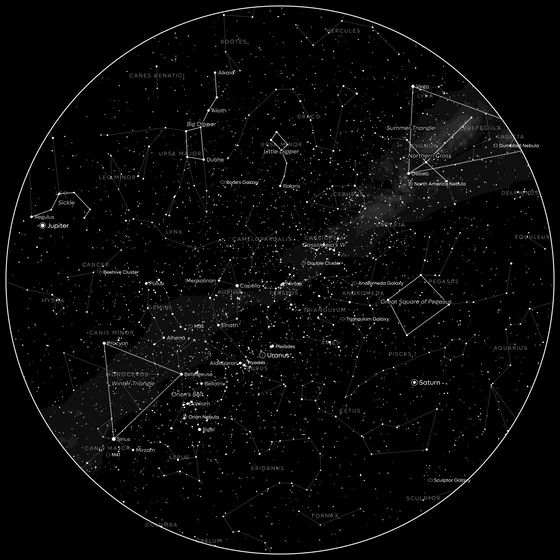
The brightest star in the night sky is Sirius, the Dog Star. It shines so brightly for two reasons. It is close: its light takes 8.6 years to reach us. And it is bright in itself, giving out far more light than the Sun. From the north you see it on winter evenings, low in the south. From the south it rides high on summer evenings. Orion's Belt points the way to it.

The Moon's distance from Earth right now
382,139 km
Measured
Live · as of 4 Nov 2026, 14:10 UTC
Venus's distance from Earth
43,179,735 km
Measured
Live · as of 4 Nov 2026
Jupiter's distance from Earth
814,563,643 km
Measured
Live · as of 4 Nov 2026

How bright is Sirius?

The brightest star of the night

Astronomers measure brightness in magnitudes, and the scale runs backwards: the lower the number, the brighter the star. Each step of one is about two and a half times brighter. Sirius has a magnitude of -1.46, which puts it below zero, brighter than any other star in our sky. The faintest stars you can see on a really dark night are about magnitude 6.5.

Only the Moon and some of the planets outshine it: Venus and Jupiter, and Mars and Mercury at their best. Venus can reach magnitude -4.92.

So when can you actually see it? From Europe, North America and the rest of the north, Sirius is an evening star from about December to March, low in the southern sky. From the far Arctic it never rises at all. From Australia, South Africa and South America it climbs high overhead on summer evenings. Sirius is bright enough to shine through the glare of a city, so you don't need a dark sky to find it.

-1.46 magApparent visual magnitude of Sirius

How do I find Sirius?

Follow Orion's Belt down

The easiest way to find Sirius is to start with Orion. On a winter evening in the north, face south and look for three bright stars in a short, straight row. That is Orion's Belt. Follow the line of the belt down and to the left, for a little over two fists held at arm's length, and the first very bright star you reach is Sirius. In the Southern Hemisphere the picture is the other way up, and the belt points up towards it.

Sirius is part of the constellation Canis Major, the Great Dog, which is why it is called the Dog Star. It follows Orion, the hunter, across the sky like a dog at his heels.

Like every star, Sirius rises in the east and sets in the west, because Earth turns beneath the sky. From northern Europe it stays low all night, never far above the southern horizon. Look for it after the sky is fully dark, when it has had time to climb clear of houses and trees.

Close, and bright in itself

Why is Sirius so bright?

A star can look bright because it is powerful, or because it is near. Sirius is both. It gives out about 25 times as much light as the Sun, and it is one of our closest neighbours among the stars.

Many stars are far more powerful. Rigel, in Orion, pours out vastly more light than Sirius, but it is so much farther away that it looks fainter. Its light set out between 790 and 1,030 years ago. The light from Sirius left only 8.6 years ago.

Sirius is also getting closer. It is moving towards us at about 5.5 kilometres per second, fast enough to cross from London to New York in about 17 minutes. Since you opened this page, Sirius has come 0 kilometres closer.

9,469,999,999,999,999,545,840,762,880 WLuminosity (total power output) of Sirius A

Why does Sirius twinkle red and green?

Why does Sirius flash colours?

On a cold night you may see Sirius flicker red, green and blue, several times a second. The colours are not coming from the star. Sirius is a white star, hotter than the Sun.

The flashing happens in our own air. Earth's atmosphere bends starlight a little, and it bends each colour by a slightly different amount, like a prism. Moving pockets of warmer and cooler air shift those colours in and out of your line of sight, so you see one colour, then another.

The effect is strongest close to the horizon, where starlight passes through much more air before it reaches you. That is why it is so striking from Europe and much of North America, where Sirius never climbs high. From a southern summer sky, with Sirius overhead, it shines far more steadily.

Does Sirius have a companion?

The Pup, a hidden companion

Sirius is not alone. In 1844 the astronomer Friedrich Bessel found small, regular wobbles in its path across the sky, and realised that an unseen companion must be pulling on it. In 1862 Alvan Clark and his father saw the companion for the first time. It is called Sirius B, and sometimes the Pup.

The two stars circle each other once every 50.13 years. Sirius B is a white dwarf: the hot core left behind by a star that has run out of fuel. Long ago it was the heavier of the pair, so it aged faster, threw off its outer layers and shrank.

What is left is extraordinary. Sirius B holds about 1 times the mass of the Sun, yet it is only about 11,000 kilometres across. Earth is about 1.1 times as wide. Sirius B is so much fainter than Sirius that it is lost in its glare, and you need a large telescope to see it.

2,024,000,000,000,000,033,491,081,232,384 kgMass of Sirius B, the white dwarf companion of Sirius

Why is it called the Dog Star?

The Dog Star and the dog days

The ancient Greeks, Romans and Egyptians watched Sirius closely. In high summer it rose at the same time as the Sun, hidden in the dawn glare. They believed its heat added to the Sun's and made those weeks the hottest of the year. The Romans counted the dog days from 3 July to 11 August, the weeks around the time Sirius rose with the Sun.

The heat of summer has nothing to do with Sirius. It comes from the tilt of Earth's axis: in the northern summer, the North Pole leans towards the Sun. But the name has stayed, and so has the habit of looking for Sirius as the year turns.

Sirius may be a destination too, of a kind. Voyager 2, now in interstellar space, is heading in its direction. It will take hundreds of thousands of years to pass it, at a great distance.

The light leaving Sirius tonight will reach Earth {{fact:sirius.distance}} years from now. Where will you be when it arrives?

Questions people ask

What are the three brightest stars in the night sky?

Sirius is the brightest, then Canopus, then Alpha Centauri, whose two bright stars look like one to the eye. Canopus and Alpha Centauri sit far down in the southern sky, so from northern Europe and most of North America you can't see them. From there, the next brightest star after Sirius is Arcturus.

Is Sirius brighter than Venus?

No. Venus is far brighter, at up to magnitude -4.92, and Jupiter is brighter too. But Venus only shows in the west after sunset or the east before sunrise, while Sirius can be up in the middle of the night. If a bright light is flashing colours low in the south on a winter evening, it is probably Sirius.

What is the brightest star in the sky tonight?

Whenever Sirius is above the horizon, it is the brightest star in the sky. When it isn't, as on summer evenings in the north, the brightest star is usually Arcturus or Vega, and from the south Canopus or Alpha Centauri. A light brighter than Sirius is the Moon or a planet, not a star.

Can you see Sirius from the Southern Hemisphere?

Yes, and it looks even better. From Australia, South Africa or South America, Sirius climbs high on summer evenings, from about December to March, where it twinkles far less than it does low in a northern sky.

Why is Sirius called the Dog Star?

Because it is the brightest star in Canis Major, the Great Dog, the constellation that follows Orion the hunter across the sky.

How do we know?

Every number on this page has a source

Show the 40 numbers and their sources
FactValueCertaintySourceAs of
Apparent visual magnitude of Polaris2.02 magMeasured, with errorSIMBAD, CDS Strasbourg (CfA mirror)
NASA HEASARC
arXiv (accepted, The Astrophysical Journal)
4 Nov 2026
Apparent visual magnitude of Sirius-1.46 magMeasured, with errorSIMBAD, CDS Strasbourg (CfA mirror)
NASA HEASARC
IAU WGSN
4 Nov 2026
Apparent visual magnitude of Vega0.03 magMeasured, with errorSIMBAD, CDS Strasbourg (CfA mirror)
NASA HEASARC
IAU WGSN
4 Nov 2026
Diameter of Sirius B, the white dwarf companion of Sirius11,270 kmMeasured, with errorThe Astrophysical Journal
International Astronomical Union / The Astronomical Journal
4 Nov 2026
Distance to Rigel860 lyEstimatedCDS / SIMBAD
CDS / SIMBAD
Astronomy & Astrophysics
31 Oct 2026
Distance to Sirius8.6 lyMeasured, with errorCDS / SIMBAD
Astronomy & Astrophysics
2 Apr 1991
Earth's average distance from the Sun in kilometres150,000,000 kmMeasuredNASA
22 Oct 2026
Earth's diameter at the equator12,756 kmMeasuredNASA NSSDCA
27 Oct 2026
Faintest star the eye can see from a city centre (limiting magnitude)2.0 magDebatedU.S. National Park Service
Sky & Telescope
4 Nov 2026
Faintest star the eye can see from a suburb (limiting magnitude)4.0 magDebatedU.S. National Park Service
Sky & Telescope
4 Nov 2026
Faintest star the eye can see in a perfectly dark sky (naked-eye limiting magnitude)6.5 magEstimatedNASA Science (Night Sky Network)
NASA GSFC, Imagine the Universe!
4 Nov 2026
Great-circle distance between London and New York5,570 kmMeasured, with errorGeoNames
NASA NSSDCA
GeoNames
27 Oct 2026
Jupiter's angle from the Sun in our sky right now (plus: evening sky, minus: morning sky)-77 degreesMeasuredNASA JPL
4 Nov 2026, 14:00 UTC
Jupiter's brightness right now, seen from Earth's centre (apparent magnitude)-2.0 magMeasured, with errorNASA JPL
Astronomy and Computing (Elsevier); preprint on arXiv
4 Nov 2026, 14:00 UTC
Jupiter's distance from Earth814,563,640 kmMeasuredNASA JPL
NASA NSSDCA
4 Nov 2026
Luminosity (total power output) of Sirius A9,469,999,999,999,999,545,840,762,880 WMeasured, with errorThe Astrophysical Journal
4 Nov 2026
Mars's angle from the Sun in our sky right now (plus: evening sky, minus: morning sky)-82 degreesMeasuredNASA JPL
4 Nov 2026, 14:00 UTC
Mars's brightness right now, seen from Earth's centre (apparent magnitude)0.8 magMeasured, with errorNASA JPL
Astronomy and Computing (Elsevier); preprint on arXiv
4 Nov 2026, 14:00 UTC
Mass of Sirius B, the white dwarf companion of Sirius2,024,000,000,000,000,033,491,081,232,384 kgMeasured, with errorThe Astrophysical Journal
Monthly Notices of the Royal Astronomical Society
4 Nov 2026
Mass of the Sun1,988,399,999,999,999,986,508,702,416,896 kgMeasuredNASA NSSDCA
International Astronomical Union / The Astronomical Journal
27 Oct 2026
Mercury's angle from the Sun in our sky right now (plus: evening sky, minus: morning sky)0 degreesMeasuredNASA JPL
4 Nov 2026, 14:00 UTC
Mercury's brightness right now, seen from Earth's centre (apparent magnitude)6.8 magMeasured, with errorNASA JPL
Astronomy and Computing (Elsevier); preprint on arXiv
4 Nov 2026, 14:00 UTC
Neptune's angle from the Sun in our sky right now (plus: evening sky, minus: morning sky)140 degreesMeasuredNASA JPL
4 Nov 2026, 14:00 UTC
Neptune's brightness right now, seen from Earth's centre (apparent magnitude)7.7 magMeasured, with errorNASA JPL
Astronomy and Computing (Elsevier); preprint on arXiv
4 Nov 2026, 14:00 UTC
Orbital period of Sirius A and Sirius B around each other50.13 yearsMeasuredThe Astrophysical Journal
4 Nov 2026
Saturn's angle from the Sun in our sky right now (plus: evening sky, minus: morning sky)147 degreesMeasuredNASA JPL
4 Nov 2026, 14:00 UTC
Saturn's brightness right now, seen from Earth's centre (apparent magnitude)0.5 magMeasured, with errorNASA JPL
Astronomy and Computing (Elsevier); preprint on arXiv
4 Nov 2026, 14:00 UTC
Speed at which Sirius is moving towards the Sun (radial velocity)5.5 km/sMeasured, with errorSIMBAD, CDS Strasbourg (CfA mirror)
SIMBAD, CDS Strasbourg (CfA mirror)
4 Nov 2026
The Moon's average distance from Earth384,400 kmMeasuredNASA
22 Oct 2026
The Moon's brightness right now, seen from Earth's centre (apparent magnitude)-8.6 magMeasured, with errorNASA JPL
NASA JPL
4 Nov 2026, 14:10 UTC
The Moon's distance from Earth right now382,139 kmMeasuredNASA JPL
NASA
4 Nov 2026, 14:10 UTC
The Sun's total power output (luminosity)382,800,000,000,000,008,824,815,616 WMeasuredThe Astronomical Journal (IAU)
NASA NSSDCA
28 Oct 2026
Typical adult walking speed5 km/hEstimatedPhysiotherapy (Elsevier)
27 Oct 2026
Typical cruising speed of a long-haul airliner907 km/hEstimatedEUROCONTROL
EUROCONTROL
27 Oct 2026
Uranus's angle from the Sun in our sky right now (plus: evening sky, minus: morning sky)-158 degreesMeasuredNASA JPL
4 Nov 2026, 14:00 UTC
Uranus's brightness right now, seen from Earth's centre (apparent magnitude)5.6 magMeasured, with errorNASA JPL
Astronomy and Computing (Elsevier); preprint on arXiv
4 Nov 2026, 14:00 UTC
Venus's angle from the Sun in our sky right now (plus: evening sky, minus: morning sky)-18 degreesMeasuredNASA JPL
4 Nov 2026, 14:00 UTC
Venus's brightness at its brightest, seen from Earth (apparent magnitude)-4.92 magMeasured, with errorAstronomy and Computing (Elsevier); preprint on arXiv
NASA NSSDCA
4 Nov 2026
Venus's brightness right now, seen from Earth's centre (apparent magnitude)-4.4 magMeasured, with errorNASA JPL
Astronomy and Computing (Elsevier); preprint on arXiv
4 Nov 2026, 14:00 UTC
Venus's distance from Earth43,179,736 kmMeasuredNASA JPL
NASA NSSDCA
4 Nov 2026