
The Universe Counts

What is the North Star?

447

light-years · Distance from the Sun to Polaris

The North Star is Polaris, a star that sits almost exactly above Earth's North Pole. As Earth turns, every other star circles around it, while Polaris barely moves. That makes it a guide: face it, and you are facing north. Polaris is not especially bright: dozens of stars outshine it. It is a giant star, far larger than the Sun, and its light takes about 450 years to reach us. From the Southern Hemisphere you can't see it at all.

The Moon's distance from Earth right now
382,139 km
Measured
Live · as of 4 Nov 2026, 14:10 UTC
The Sun's distance from Earth
148,369,555 km
Measured
Live · as of 4 Nov 2026
Jupiter's distance from Earth
814,563,525 km
Measured
Live · as of 4 Nov 2026

Why doesn't the North Star move?

The star that stays still

The stars are not moving across the sky. We are turning beneath them. Earth spins on an axis that runs through the North and South Poles, and the northern end of that axis points at one spot in the sky. Polaris happens to sit very close to that spot.

So as the night goes on and Earth turns, the other stars swing round in circles, and Polaris stays almost exactly where it is. A long-exposure photograph of the northern sky shows every star drawn as an arc around one point, with Polaris making the smallest circle of all. It is not perfectly on the pole: it is a little more than the width of the full Moon away, so it traces a tiny circle of its own each night.

At the equator, Earth's spin carries the ground along at 0.4651 kilometres per second. Since you opened this page, the equator has turned 0 kilometres beneath the sky, and Polaris has hardly shifted.

0.4651 km/sSpeed of Earth's spin at the equator
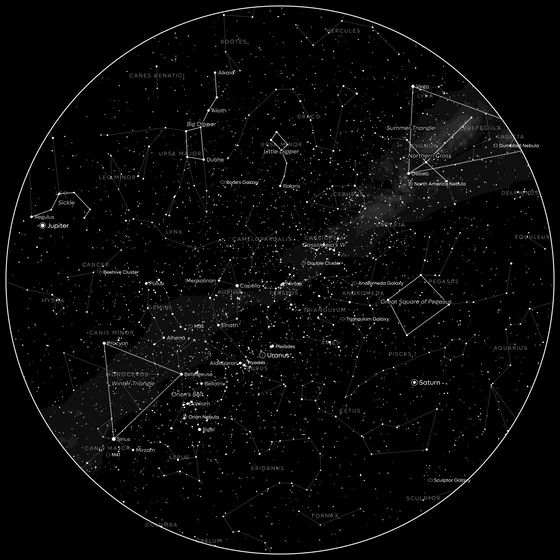
How do I find the North Star?

Find it from the Big Dipper

Start with the Big Dipper, the seven bright stars that in Britain are called the Plough. From most of Europe and Canada it never sets, so you can find it on any clear night; farther south it dips low in autumn evenings. The two stars at the end of the Dipper's bowl, away from the handle, are called the Pointers. Draw a line through them, out from the top of the bowl, and keep going. The first fairly bright star you reach is Polaris.

Polaris is the last star in the handle of the Little Dipper, a fainter pattern that you may only see from a dark site.

How high should you look? Polaris stands as many degrees above your horizon as your latitude. To measure, use your hand: a fist held at arm's length covers about 10 degrees of sky. From the North Pole, Polaris is straight overhead. From the equator, it sits right on the horizon. From London or Copenhagen it is a little over halfway up.

10 degreesAngle of sky covered by a fist held at arm's length

Is the North Star the brightest star?

Not the brightest star

Many people expect the North Star to be the brightest star in the sky. It isn't. On the magnitude scale, which runs backwards so that lower numbers are brighter, Polaris is 2.02. Depending on how you count close pairs of stars, between 47 and 50 stars outshine it. Sirius, the brightest, is -1.46.

Polaris is still easy to see, even from a town, because it is bright enough to cut through light pollution and there are few bright stars near it to confuse you. What makes it special is its place in the sky, not its glow.

Polaris looks modest because it is far away. It is about 52 times farther from us than Sirius. Measurements place it between 433 and 521 light-years away, and the next data from the Gaia spacecraft should help settle the question.

2.02 magApparent visual magnitude of Polaris

What kind of star is Polaris?

What the eye can't tell

To the eye Polaris is one steady point. In fact it is at least three stars. The bright one is a yellow supergiant, a star that has swollen far larger than the Sun. It has a close companion that circles it, and a fainter one farther out.

The supergiant is also a Cepheid, a kind of star that slowly swells and shrinks, brightening and dimming in a regular rhythm. Polaris is the nearest Cepheid to us. Its pulses are so small that the eye can't see them, but they matter. Astronomers use Cepheids to measure the distances to other galaxies, because the rhythm of a Cepheid's pulse reveals how much light it gives out. Polaris, close enough to study in detail, could help check that method, once its own distance is pinned down.

Has Polaris always been the North Star?

North Stars come and go

Polaris has not always been the North Star, and it won't be forever. Earth's axis wobbles slowly, like a spinning top, and the point in the sky it aims at traces a wide circle. One full turn of that wobble takes about 26,000 years, about 5 times as long as all of recorded history.

When the first pyramids were being built in Egypt, the North Star was Thuban, a modest star in the constellation of the Dragon. Today it is Polaris, and the pole is still creeping closer to it, until around the end of this century. Then it will slowly draw away. About half a turn of the wobble from now, the pole will lie near Vega, one of the brightest stars in the northern sky.

Anyone who looks for the North Star is taking part in a very old human habit. The star changes; the looking does not.

25,772 yearsPeriod of Earth's axial precession (one full circle of the wobble of Earth's axis)

The North Star has changed before and will change again, but tonight it is Polaris. Where does it stand above your horizon?

Questions people ask

Can you see the North Star from the Southern Hemisphere?

No. South of the equator, Polaris is below the horizon. There is no bright south pole star either. The faint star Sigma Octantis lies close to the south pole of the sky, but it is too dim to find easily. Instead, people in the south use the stars of the Southern Cross: its long arm points towards the south pole of the sky, a patch with few bright stars that lies above due south.

Can you see the North Star every night?

From most of the Northern Hemisphere, yes, whenever the sky is clear and dark. Because it sits almost on the pole, it never rises or sets, and it is in the same place all night and all year.

Why is the North Star important?

Because it shows you which way is north, and how far north you are. For centuries, sailors and travellers used it to find their way at night, and to work out their latitude from how high it stood.

Is the North Star a planet?

No. Polaris is a star, much larger and brighter in itself than the Sun. Planets shift from night to night against the stars, while Polaris stays put.

Can you see the North Star from Australia?

No. All of Australia is south of the equator, so Polaris never rises there. Australians find south using the Southern Cross instead.

How do we know?

Every number on this page has a source

Show the 19 numbers and their sources
FactValueCertaintySourceAs of
Angle of sky covered by a fist held at arm's length10 degreesEstimatedNASA Science
NASA Chandra X-ray Center
4 Nov 2026
Apparent visual magnitude of Polaris2.02 magMeasured, with errorSIMBAD, CDS Strasbourg (CfA mirror)
NASA HEASARC
arXiv (accepted, The Astrophysical Journal)
4 Nov 2026
Apparent visual magnitude of Sirius-1.46 magMeasured, with errorSIMBAD, CDS Strasbourg (CfA mirror)
NASA HEASARC
IAU WGSN
4 Nov 2026
Diameter of a regulation football (size 5)22 cmMeasured, with errorThe IFAB
27 Oct 2026
Distance from the Sun to Polaris447 lyEstimatedarXiv (accepted, The Astrophysical Journal)
SIMBAD, CDS Strasbourg (CfA mirror)
The Astrophysical Journal
4 Nov 2026
Distance to Sirius8.6 lyMeasured, with errorCDS / SIMBAD
Astronomy & Astrophysics
2 Apr 1991
Earth's average distance from the Sun in kilometres150,000,000 kmMeasuredNASA
22 Oct 2026
Earth's diameter at the equator12,756 kmMeasuredNASA NSSDCA
27 Oct 2026
Jupiter's distance from Earth814,563,523 kmMeasuredNASA JPL
NASA NSSDCA
4 Nov 2026
Length of recorded history, since the first writing5,200 yearsEstimatedBritish Museum
27 Oct 2026
Number of stars in the night sky brighter than Polaris (close doubles counted once)47DebatedNASA HEASARC
NASA HEASARC
SIMBAD, CDS Strasbourg (CfA mirror)
4 Nov 2026
Period of Earth's axial precession (one full circle of the wobble of Earth's axis)25,772 yearsMeasured, with errorNASA Science
NASA Science
4 Nov 2026
Speed of Earth's spin at the equator0.4651 km/sMeasuredNASA NSSDCA
18 Oct 2026
The International Space Station's orbital speed7.66 km/sMeasuredCelesTrak
NASA
27 Oct 2026
The Moon's average distance from Earth384,400 kmMeasuredNASA
22 Oct 2026
The Moon's distance from Earth right now382,139 kmMeasuredNASA JPL
NASA
4 Nov 2026, 14:10 UTC
The Sun's distance from Earth148,369,555 kmMeasuredNASA JPL
NASA NSSDCA
4 Nov 2026
Typical adult walking speed5 km/hEstimatedPhysiotherapy (Elsevier)
27 Oct 2026
Typical cruising speed of a long-haul airliner907 km/hEstimatedEUROCONTROL
EUROCONTROL
27 Oct 2026