
The Universe Counts

How do you find Orion?

1,300

light-years · Distance from the Sun to the Orion Nebula (the Orion Nebula Cluster)

To find Orion, look for three bright stars close together in a short, straight row. That is Orion's Belt, and it is one of the easiest patterns in the whole sky. Above it shines red Betelgeuse, below it blue-white Rigel. Orion is an evening sight from about December to March: in the south of the sky from the Northern Hemisphere, in the north and upside down from the Southern. Hanging from the Belt is a fuzzy patch, the Orion Nebula, where new stars are being born. Its light left it between 1,230 and 1,370 years ago.

The Moon's distance from Earth right now
382,133 km
Measured
Live · as of 4 Nov 2026, 14:00 UTC
The Sun's distance from Earth
148,369,619 km
Measured
Live · as of 4 Nov 2026
Jupiter's distance from Earth
814,567,549 km
Measured
Live · as of 4 Nov 2026

Where is Orion in the sky?

Start with the Belt

Orion's Belt is three fairly bright stars, evenly spaced in a line. From west to east they are Mintaka, Alnilam and Alnitak. The row is short: three fingers held at arm's length will cover it.

Around the Belt, four bright stars make a tall box, like the outline of an hourglass: Betelgeuse and Bellatrix at the shoulders, Rigel and Saiph at the knees. Below the Belt hangs a shorter line of fainter stars, the Sword.

The Belt lies almost exactly on the celestial equator, the line in the sky above Earth's equator. That means Orion can be seen from almost everywhere on Earth. It also means the Belt rises due east and sets due west, wherever you are.

Orion is a good test of how dark your sky is. From a city centre you may see little more than the Belt and the brightest stars around it. Under a dark sky the whole figure fills in with fainter stars.
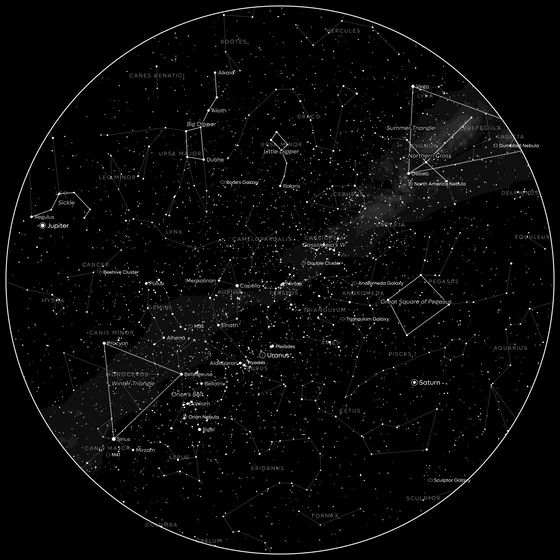
Orion's season

When can you see Orion?

Orion is not up in the evening all year. As Earth travels around the Sun, the Sun passes in front of different stars, and the night side of Earth faces a slowly changing sky.

In the north, Orion appears in the east in the late evening during November. By midwinter it is up for most of the night, including early in the new year, when Earth makes its closest pass of the Sun, in 59d 12h 23m 23s. January to March are the best months for an evening look, with Orion due south in mid-evening during February. By April it sinks into the west after sunset, and from about mid-May to July it is lost in the Sun's glare. It returns before dawn in late summer.

The Southern Hemisphere shares the same calendar but turns Orion upside down. On a summer evening in Sydney or Cape Town, Orion stands high in the north on his head, with Rigel above Betelgeuse. Many Australians know the Belt and Sword as the Saucepan.

Earth carries you round the Sun at 29.78 kilometres per second. Since you opened this page, it has carried you 0 kilometres closer to the next evening with Orion in it.

29.78 km/sEarth's speed around the Sun

Which are Orion's brightest stars?

Betelgeuse and Rigel

Look closely and you can see that Orion's two brightest stars are different colours. Betelgeuse, at the top left as seen from the north, glows orange-red. Rigel, at the bottom right, is blue-white.

Both are supergiants, stars far larger and more powerful than the Sun. Betelgeuse is a red supergiant, so swollen that if it took the Sun's place it would reach beyond the orbit of Jupiter. Rigel is a blue supergiant and usually the brighter of the two, at magnitude 0.13. On the magnitude scale, which runs backwards, smaller numbers mean brighter stars. Betelgeuse changes: over the years it has ranged between 0 and 2, so it sometimes outshines Rigel.

The two stars look side by side, but they are not neighbours. Betelgeuse lies between 440 and 880 light-years away; astronomers still disagree on the exact figure. Rigel is between 790 and 1,030 light-years away. A constellation is a pattern seen from one place, Earth, not a group of stars that belong together.

0.13 magApparent visual magnitude of Rigel

Betelgeuse and the Great Dimming

Is Betelgeuse about to explode?

Late in 2019, Betelgeuse began to fade. By February 2020 it had lost more than half its light, a change anyone could see by eye. Some people wondered whether it was about to explode. The real cause was closer to home: the star had thrown off a huge piece of its surface, which cooled into a cloud of dust and blocked some of its light. By 2023 it was back, and brighter than usual.

Betelgeuse will explode one day as a supernova. By the standards of a star's life, that is soon. By ours, it may not be. The usual estimate is that it is not likely for about another hundred thousand years. A few studies suggest it could be much sooner, within centuries. Put together, the time left is between 300 and 100,000 years, and experts disagree on where in that range the truth lies.

When it does happen, we will know. For about three months a point of light about as bright as a quarter Moon will shine where Betelgeuse was. It will then fade, but stay visible to the eye for years. Orion will have lost a shoulder.

between 300 and 100,000 yearsExpected time until Betelgeuse explodes as a supernova

What is the fuzzy star in Orion's Sword?

The Orion Nebula, a star nursery

Look at the middle star of Orion's Sword. Even with the eye alone, under a moderately dark sky, it looks slightly fuzzy. Binoculars show why: it is not a star but a glowing cloud of gas and dust, the Orion Nebula.

The nebula is a nursery. Hundreds of new stars are forming inside it, and at its heart four young, hot stars, the Trapezium, light up the gas around them. A small telescope shows them as a tight little group.

The Orion Nebula is one of the nearest places where stars are being born, which makes it a natural laboratory for astronomers. The light reaching you tonight left the nebula about 1,300 years ago.

Our own Sun was probably born in a cloud like this, 4.6 billion years ago. When you look at the Orion Nebula, you are looking at something like our own beginnings.

The light of Orion's stars and its nebula set out at different times, yet it arrives together as one figure. What will you see in it next time it rises?

Questions people ask

Where is Orion in the sky right now?

That depends on the month and the hour. In November it rises in the east in the late evening. Each night it rises a little earlier, and by February it is high in the south as soon as the sky gets dark, or high in the north from the Southern Hemisphere.

What direction do I look to see Orion?

From the Northern Hemisphere, look east when it is rising, south when it is at its highest, and west as it sets. From the Southern Hemisphere, look north when it is at its highest. The Belt always rises due east and sets due west.

What are the names of the three stars in Orion's Belt?

Alnitak, Alnilam and Mintaka. Alnilam, in the middle, is the brightest of the three.

Can I see Orion tonight?

On most nights from about November to April, yes, if the sky is clear, though in November you will need to stay up late. From May to July it is too close to the Sun to see in the evening.

Is Orion visible from the Southern Hemisphere?

Yes. It is a summer constellation there, high in the north on summer evenings, but it appears upside down, with the Belt and Sword forming the shape many people call the Saucepan.

How do we know?

Every number on this page has a source

Show the 19 numbers and their sources
FactValueCertaintySourceAs of
Age of the Sun4,567,000,000 yearsMeasured, with errorScience
NASA Science
28 Oct 2026
Apparent visual magnitude of Betelgeuse (a variable star)0.5 magMeasured, with errorarXiv / Astronomy & Geophysics
NASA HEASARC
SIMBAD, CDS Strasbourg (CfA mirror)
4 Nov 2026
Apparent visual magnitude of Rigel0.13 magMeasured, with errorSIMBAD, CDS Strasbourg (CfA mirror)
NASA HEASARC
IAU WGSN
4 Nov 2026
Diameter of a regulation football (size 5)22 cmMeasured, with errorThe IFAB
27 Oct 2026
Distance from the Sun to the Orion Nebula (the Orion Nebula Cluster)1,300 lyMeasured, with errorThe Astrophysical Journal
Astronomy & Astrophysics
The Astrophysical Journal
4 Nov 2026
Distance to Betelgeuse550 lyDebatedThe Astrophysical Journal (arXiv version)
The Astronomical Journal (arXiv version)
CDS / SIMBAD
Astronomy & Astrophysics
31 Oct 2026
Distance to Rigel860 lyEstimatedCDS / SIMBAD
CDS / SIMBAD
Astronomy & Astrophysics
31 Oct 2026
Earth's average distance from the Sun in kilometres150,000,000 kmMeasuredNASA
22 Oct 2026
Earth's diameter at the equator12,756 kmMeasuredNASA NSSDCA
27 Oct 2026
Earth's speed around the Sun29.78 km/sMeasuredNASA NSSDCA
18 Oct 2026
Expected time until Betelgeuse explodes as a supernovabetween 300 and 100,000 yearsDebatedNASA Science
Monthly Notices of the Royal Astronomical Society
Research Notes of the AAS
4 Nov 2026
Jupiter's distance from Earth814,567,547 kmMeasuredNASA JPL
NASA NSSDCA
4 Nov 2026
The International Space Station's orbital speed7.66 km/sMeasuredCelesTrak
NASA
27 Oct 2026
The Moon's average distance from Earth384,400 kmMeasuredNASA
22 Oct 2026
The Moon's distance from Earth right now382,133 kmMeasuredNASA JPL
NASA
4 Nov 2026, 14:00 UTC
The Sun's distance from Earth148,369,619 kmMeasuredNASA JPL
NASA NSSDCA
4 Nov 2026
Time until Earth's next perihelion (closest to the Sun)59d 12h 23m 23sMeasuredNASA JPL
US Naval Observatory
28 Oct 2026
Typical adult walking speed5 km/hEstimatedPhysiotherapy (Elsevier)
27 Oct 2026
Typical cruising speed of a long-haul airliner907 km/hEstimatedEUROCONTROL
EUROCONTROL
27 Oct 2026