
The Universe Counts

Your life in the universe

Every birthday marks one lap of the Sun: about 940 million kilometres, at 29.78 kilometres a second. Give the day you were born, and this page counts your laps, shows where the Moon, the planets and Voyager 1 were on the day you arrived, and lists what we have learned about the universe since. Your birthday stays in your browser.

Shown for someone born on 9 June 1990.

Since 9 June 1990, Earth has carried someone born that day

34,259,589,584

kilometres around the Sun, and counting

That is 36 laps of the Sun, and 45% of the next one.

Laps of the Sun

A birthday is a lap: 940 million kilometres, back to the same place among the stars.

Lap 37 ends on 9 June 2027, when Earth is back where it was on 9 June 1990, give or take a day.

The day of that birth

Saturday 9 June 1990

The Moon

Waning gibbous

99% of its face lit by the Sun.

Voyager 1

6.2 billion km

from the Sun, on its way out. It had left Earth 12 years before.

Planets known around other stars

0

None had been found yet. Today: 6,473.

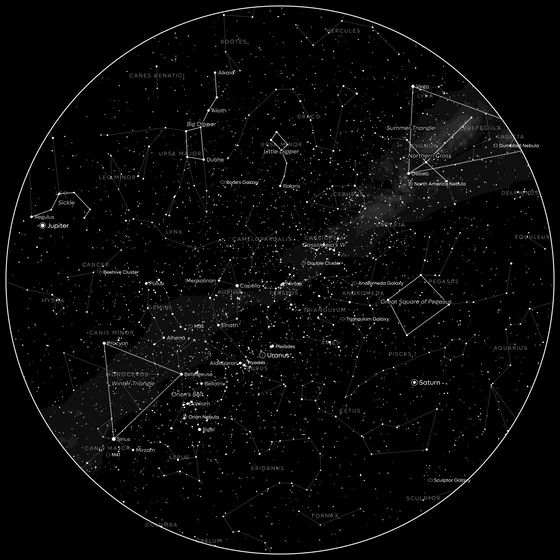
Where the planets were

In that lifetime

The known universe grew.

  1. age 1The first planets beyond the solar system are found, around a pulsar9 January 1992
  2. age 5The first planet around a Sun-like star is announced6 October 1995
  3. age 6Comet Hale-Bopp is closest to the Sun1 April 1997
  4. age 8Astronomers find that the universe's expansion is speeding upSeptember 1998
  5. age 10People begin living on the International Space Station, and someone has been there ever since2 November 2000
  6. age 14Huygens lands on Titan, the first landing in the outer solar system14 January 2005
  7. age 22Voyager 1 enters interstellar space25 August 2012
  8. age 25New Horizons flies past Pluto14 July 2015
  9. age 25The first gravitational waves are detected14 September 2015
  10. age 27A total solar eclipse spans the United States21 August 2017
  11. age 28Voyager 2 enters interstellar space5 November 2018
  12. age 28Chang'e-4 makes the first landing on the far side of the Moon3 January 2019
  13. age 28The first image of a black hole (M87*)10 April 2019
  14. age 30Perseverance lands on Mars18 February 2021
  15. age 30Ingenuity makes the first powered flight on another planet19 April 2021
  16. age 31The James Webb Space Telescope is launched25 December 2021
  17. age 31The first image of the black hole at the centre of our galaxy12 May 2022
  18. age 32Webb's First Deep Field is revealed11 July 2022
  19. age 32NASA's DART spacecraft strikes the asteroid Dimorphos26 September 2022
  20. age 33A total solar eclipse crosses North America8 April 2024
  21. age 33A geomagnetic storm reaches G5, the top of NOAA's scale10 May 2024
  22. age 35The third known interstellar object, comet 3I/ATLAS, is found1 July 2025
  23. age 35Artemis II carries four people around the Moon1 April 2026
  24. age 36A total solar eclipse crosses Greenland, Iceland and Spain12 August 2026
  25. age 36The first Starship flight to reach orbit lifts off28 September 2026
  26. age 36A Starship ship is caught by its launch tower for the first time14 November 2026
  27. age 36Voyager 1 becomes the first spacecraft one light-day from Earth18 November 2026

Every date is a sourced fact: from NASA, ESA, the observatories and the discovery papers.

Further out

Around the Milky Way

284 billion

kilometres with the Sun, at 247 kilometres a second. One lap of the galaxy takes 203 million years; that life so far is 0.000018% of one.

Through the afterglow of the Big Bang

425 billion

kilometres against the cosmic microwave background, at 369.82 kilometres a second.

Days on Earth

13,315

Each one a turn of the planet, from night into morning.

Laps of the Sun

A birthday is a lap

Earth goes once around the Sun in a year, so every birthday you have had marks another full circle. The path is 940 million kilometres long, and Earth covers it at 29.78 kilometres a second. Since you opened this page, it has carried you 0 kilometres along it.

A birthday is not the end of a lap to the minute. Earth takes about a quarter of a day longer than a calendar year to come back to the same place among the stars, and every fourth year a leap day catches the calendar up. So each lap ends on your birthday, give or take a day.

The Sun stays at the middle of every lap. Everyone you have ever met has gone around it with you, on the same planet, at the same speed.

939,900,000 kmLength of Earth's orbit around the Sun
Where everything was

The day you arrived

On any date from 1900 to 2100 we can say where the Moon and the planets stood. The positions come from NASA's planetary ephemeris, the tables JPL uses to steer its spacecraft. For the spacecraft leaving the solar system we keep NASA's own positions, month by month, from the day each one left Earth. Voyager 1 is now 25.8 billion kilometres from the Sun.

The count of planets around other stars comes from NASA's Exoplanet Archive, by the month each discovery was published. The first ones, circling a pulsar, were reported on 9 January 1992. Today there are 6,473. Anyone born before then was born before a single planet around another star was known.

Further out

Farther than the lap

The Sun is moving too. It carries Earth, and all of us, around the centre of the Milky Way at 247 kilometres a second. One lap of the galaxy takes between 201 million and 204 million years. Since the Sun was last where it is now, the whole of human history has happened, and far more.

Measured against the cosmic microwave background, the oldest light there is, the Sun moves at 369.82 kilometres a second. That light was set free when the universe was young, long before there were stars, and every one of us moves through it together.

203,000,000 yearsTime for the Sun to orbit the centre of the Milky Way once

What would you like to carry into your next lap?

Questions people ask

How far have I travelled around the Sun since I was born?

About 940 million kilometres for every year of your life, at 29.78 kilometres a second. Give your birthday at the top of this page to see your own number, counting up as you read.

Is my birthday exactly one orbit of the Sun?

Nearly. Earth comes back to the same place among the stars about a quarter of a day after the calendar year ends, and leap days keep the calendar in step. So your birthday is the end of a lap, give or take a day.

How fast am I moving right now?

Earth's spin carries you at up to 0.4651 kilometres a second at the equator. Its orbit carries you around the Sun at 29.78, and the Sun carries us around the galaxy at 247. These speeds point in different directions, so they don't simply add up; how fast you are moving depends on what you measure against.

Is my birthday sent to you?

No. It is kept only in this browser, and the page asks our server only for that day's sky, the same file for everyone born that day. "Forget it", under the form, removes it.

How do we know?

Every number on this page has a source

Show the 9 numbers and their sources
FactValueCertaintySourceAs of
Confirmed exoplanets in the NASA Exoplanet Archive6,473MeasuredNASA Exoplanet Science Institute (Caltech/IPAC)
NASA Exoplanet Science Institute (Caltech/IPAC)
NASA
NASA
22 Nov 2026, 06:00 UTC
Earth's speed around the Sun29.78 km/sMeasuredNASA NSSDCA
18 Oct 2026
Length of Earth's orbit around the Sun939,900,000 kmMeasuredNASA NSSDCA
27 Oct 2026
Speed of Earth's spin at the equator0.4651 km/sMeasuredNASA NSSDCA
18 Oct 2026
The first planets beyond the solar system are found, around a pulsar34y 318d 1hMeasuredNature
9 Jan 1992
The Sun's speed relative to the cosmic microwave background369.82 km/sMeasured, with errorAstronomy & Astrophysics
17 Jul 2018
The Sun's total speed around the centre of the Milky Way247 km/sMeasured, with errorThe Astrophysical Journal
1 Nov 2019
Time for the Sun to orbit the centre of the Milky Way once203,000,000 yearsMeasured, with errorarXiv / The Astrophysical Journal
NASA
1 Nov 2019
Voyager 1's distance from the Sun25,795,121,218 kmMeasuredNASA JPL
22 Nov 2026