
The Universe Counts

Where is Juno now?

771,476,830

kilometres · Juno's distance from Earth

Juno is NASA's spacecraft in orbit around Jupiter. The number above tells you exactly how far it is from Earth this moment; a radio signal would take 43 minutes to cover the gap. NASA's official mission pages, loaded on 11 November 2026, still say the last authorised extension ran through September 2025. The craft is still at Jupiter, and JPL was still tracking it after that date, but this research found no public NASA authorisation of a second funded extension. Juno has already shown deep winds, polar cyclones and a dilute, fuzzy core.

Right now

Juno's distance from Jupiter
-4.4 million km
Measured
Live · as of 11 Nov 2026
Juno's speed relative to the Sun
27.3 km/s
Measured
Live · as of 11 Nov 2026
Time since Juno entered orbit around Jupiter
10y 139d 23h
Measured
Time since Juno's launch
15y 109d 3h
Measured

What is Juno?

A spacecraft built to go under Jupiter's clouds

Juno is a NASA orbiter, managed by the Jet Propulsion Laboratory and built at Lockheed Martin, and launched on 5 August 2011. It was sent to pass close over Jupiter's poles, measure the planet's gravity and magnetic field, and look beneath the cloud tops at the atmosphere and the interior.

It entered orbit on 5 July 2016 (early 5 July UTC; NASA often gives the date as 4 July 2016, the evening of that arrival in the United States). From that orbit it has flown not only over the planet but close past three of its large moons.

The name is from the goddess who could see through the clouds that hid Jupiter. The spacecraft is still at the planet. What official pages currently say about how long it may stay is a separate, and unsettled, question, taken up below.
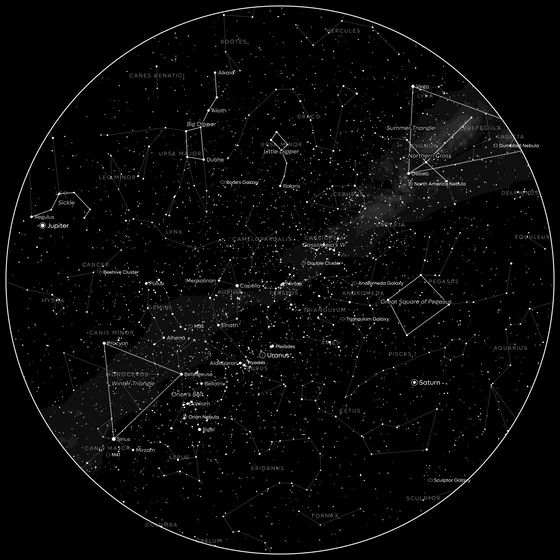
What it found

Winds, cyclones and a fuzzy core

Juno's most useful work has been to show what Jupiter is like underneath the familiar bands. The winds are not a thin surface layer: they run deep into the atmosphere. At both poles the spacecraft has found clusters of cyclones, arranged around a central storm rather than a single simple vortex.

Gravity measurements point to a core that is not a sharp, compact ball of rock, but something more dilute — a fuzzy core, mixed with the surrounding metallic hydrogen rather than sitting in a clean boundary beneath it. That finding is written on NASA's current mission overview, even while other lines on the same page still mention September 2025.

Those results are why the mission was worth extending once, and why later spacecraft are being sent to the icy moons that orbit the same planet. They are also why this page should not be only a distance ticker: the distance is useful because the spacecraft has already changed what we know about Jupiter.

The moons it has already visited

Close passes at Ganymede, Europa and Io

On its way around Jupiter, Juno has also been flown close past three of the large moons. It passed Ganymede, then Europa, then Io, and it has kept returning science from those encounters years after arrival.

Europa is the moon with a saltwater ocean under an ice shell. Io is the most volcanically active world in the solar system; as recently as 22 July 2026, NASA reported Juno's first measurements of the temperature below Io's surface, showing heating in the shallow subsurface. In May 2026 the spacecraft also recorded a close view of the inner moon Thebe.

The moons themselves do not yet have pages here, so they are named in plain words. The planet they orbit is Jupiter. Two spacecraft still on the way, Europa Clipper and Juice, will spend their prime missions on the icy moons Juno only flew past.

The September 2025 problem

Still at Jupiter, with a stale date on the official pages

On 13 January 2021 NASA authorised an extension of Juno "through September 2025, or until the spacecraft's end of life." That is the last clear public authorisation this research found. The NASA Science and JPL mission pages, both loaded on 11 November 2026, still use that September 2025 wording. The JPL page also lists the status as Current, and still has "End of Mission / September 2025" on its timeline.

Those pages are out of date as a description of what the spacecraft has done since. NASA published Juno science and images in 2026, including a close view of Thebe from 1 May 2026 and Io temperature results on 22 July 2026. JPL Horizons, revised on 3 November 2026, still carries Juno at Jupiter. Its reconstructed trajectory runs through 26 September 2026; later segments are a predicted orbit and a planning file that runs to 2 September 2028.

A planning ephemeris is not a funded extension, and a senior review of a proposed second extension is not an authorisation. This research found no public NASA decision that replaces the September 2025 line, and does not claim an extension to 2028. The live Earth distance is kept because Horizons still has a usable trajectory. The Jupiter distance changes quickly and is not a status bulletin.

-4.4 million kmJuno's distance from Jupiter

Europa Clipper and Juice

Two spacecraft still on the way

Juno is the spacecraft already at Jupiter. Two others are still travelling there, and together the three missions are why an ocean under the ice of a moon is getting this much attention.

Europa Clipper is NASA's mission to Europa, due at Jupiter in April 2030, with an Earth flyby still ahead on 3 December 2026. It will look for conditions that could support life, not for life itself. Juice, ESA's Jupiter Icy Moons Explorer, is due in July 2031 and is aimed especially at Ganymede, the largest moon and the only one with its own magnetic field.

Parker Solar Probe and BepiColombo belong to the same spacecraft family, but they are not Jupiter missions. For the planet itself, start with Jupiter.

A spacecraft that has already rewritten Jupiter's interior is still on the orbit it was built for. What would you have it measure next, if it is allowed to keep going?

Questions people ask

Where is Juno now?

In orbit around Jupiter. On 11 November 2026 it was 771 million kilometres from Earth, and -4.4 million kilometres from Jupiter. Both numbers change as the spacecraft and the planets move.

Is Juno still working?

NASA published Juno science and images in 2026, after the September 2025 date that still appears on the official mission overviews, and JPL Horizons was still tracking the spacecraft at Jupiter. The last public NASA authorisation of an extension that this research found ran through September 2025. No public authorisation of a second funded extension was found.

What has Juno discovered at Jupiter?

Deep winds, cyclones at both poles, and a dilute, fuzzy core rather than a compact one. It has also flown close past Ganymede, Europa and Io, and in 2026 it returned a close view of Thebe and the first subsurface temperature measurements of Io.

When did Juno arrive at Jupiter?

It entered orbit on 5 July 2016. NASA often gives the date as 4 July 2016, which is the evening of that arrival in the United States; the UTC clock time is early on 5 July.

Has NASA extended Juno to 2028?

Not in any public authorisation this research could find. A Horizons planning file runs to 2 September 2028, and that is not the same thing as a funded extension. Official overviews still mention September 2025.

How fast is Juno moving?

27.3 kilometres per second relative to the Sun, as of the seed used for this page. That speed changes quickly when the spacecraft is close to Jupiter, and it is not a speed relative to Earth.

How do we know?

Every number on this page has a source

Show the 14 numbers and their sources
FactValueCertaintySourceAs of
Height of Mount Everest above sea level8,848.86 mMeasuredSurvey Department, Government of Nepal
8 Dec 2020
James Webb Space Telescope's distance from Earth1,690,982 kmMeasuredNASA JPL
22 Nov 2026
Juno's distance from Earth771,476,828 kmMeasuredNASA JPL
NASA
22 Nov 2026
Juno's distance from Jupiter-4.4 million kmMeasuredNASA JPL
11 Nov 2026
Juno's distance from Thebe in the 1 May 2026 image5,000 kmMeasuredNASA
1 May 2026
Juno's speed relative to the Sun27.3 km/sMeasuredNASA JPL
11 Nov 2026
Length of a year on Jupiter11.862 yearsMeasuredNASA NSSDCA
27 Oct 2026
New Horizons' distance from Earth9,990,132,428 kmMeasuredNASA JPL
22 Nov 2026
The International Space Station's mean height above Earth425 kmMeasuredCelesTrak
NASA JSC TOPO
NASA
11 Nov 2026
Time since Juno entered orbit around Jupiter10y 139d 23hMeasuredNASA JPL
NASA
5 Jul 2016
Time since Juno's launch15y 109d 3hMeasuredNASA
NASA JPL
5 Aug 2011
Time since NASA reported Juno's first Io subsurface temperature measurements0y 123d 13hMeasuredNASA
22 Jul 2026
Voyager 1's distance from Earth25,910,875,670 kmMeasuredNASA JPL
NASA JPL
22 Nov 2026
Voyager 2's distance from Earth21,696,623,744 kmMeasuredNASA JPL
22 Nov 2026