
The Universe Counts

How far away is the Andromeda Galaxy?

2,480,000

light-years · Distance to the Andromeda galaxy

The Andromeda Galaxy is about 2.5 million light-years away. That makes it the farthest thing most people can see with their own eyes. The distance is measured to within a few per cent, not exactly: Hubble's Cepheid stars give between 2.4 million and 2.5 million light-years.

Andromeda by the numbers

Speed at which Andromeda is approaching the Milky Way
109.3 km/s
Measured, with error
Sideways speed of the Andromeda Galaxy relative to the Milky Way
57 km/s
Measured, with error
Apparent magnitude of the Andromeda Galaxy
3.1 mag
Estimated
Galaxies in the Local Group
75
Estimated

Where and when to look

The faint smudge you can see

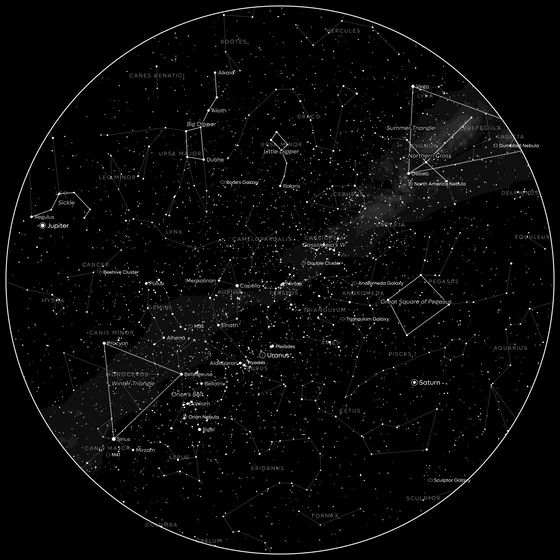
Andromeda is in the constellation of the same name and is best seen in November. Its apparent magnitude is 3.1, bright enough for the naked eye even with moderate light pollution, as NASA puts it. Look for a faint, elongated smudge, not a point.

A camera shows far more than your eye. In photographs Andromeda spans 3.5 degrees of sky, as wide as seven full Moons side by side, but to the eye only the bright core stands out. From mid-southern latitudes it stays low over the northern horizon. The night sky tonight shows where it is for your place and time.

The Triangulum Galaxy is a little farther, 2.6 million light-years away, and much fainter at magnitude 5.7. NASA says keen-eyed observers can see it from exceptionally clear and dark skies. So Andromeda is the farthest thing most people can see, and Triangulum is the farthest a few can.
The first proof of other galaxies

How far, and how we know

The light you see left Andromeda 2.5 million years ago, long before Homo sapiens, which has existed for about 320,000 years. Every star's light is old, and Andromeda's is the oldest that most people will ever see.

Until the 1920s astronomers argued over whether such smudges were inside the Milky Way. Edwin Hubble settled it by finding Cepheids in Andromeda: stars that brighten and fade on a steady rhythm, with the period giving their true brightness. From their dimness he worked out a distance of about 900,000 light-years, far outside the Milky Way as then imagined.

That was less than half of today's value. Hubble's Cepheids now give 2.5 million light-years, the most precise measurement made so far, as of 2021. A second method, the tip of the red giant branch, uses the brightest red giants and gives 2.6 million light-years. The two overlap, and each has its own uncertainty, so the safe statement is the range.

Against the Milky Way

How big

Andromeda's disk of stars is about 260,000 light-years across, by NASA's count of its faint outskirts. Estimates of its width run between 150,000 and 260,000 light-years, depending on where you stop counting: the bright part of an infrared image gives the low end, the faint outer disk the high end. The Milky Way's disc is between 100,000 and 200,000, and neither galaxy has a sharp edge. Andromeda is probably the larger, but not by a margin anyone can state.

It holds about 1 trillion stars, against between 100 billion and 400 billion in the Milky Way. Nobody has counted either: each number is a mass divided by an assumed average star. The Milky Way's width is told in How big is the Milky Way?.

And whether the two will meet

Coming closer

Andromeda is approaching the Milky Way at 109.3 kilometres per second. That speed is relative to the Milky Way as a whole, not to the Sun. Since you opened this page, Andromeda has come 0 kilometres closer to our galaxy.

A closing speed does not make a collision. Gaia and Hubble put its sideways motion at 57 kilometres per second, with a range of between 26 and 92. That decides whether the two galaxies pass or merge, and the number is uncertain. A 2025 study included the errors and the pull of Triangulum and the Large Magellanic Cloud. It found the chance that the two merge in the next 10 billion years is about even, between 40 and 60 per cent.

If they do merge, the median time is 7.6 billion years. Earlier predictions, built on the single most likely motion, had a merger certain and sooner. The authors of the 2025 study call a precise date futile on today's data. Andromeda is coming, and whether it arrives is open.

The company we keep

The Local Group and our other neighbours

Andromeda and the Milky Way are the two big galaxies of the Local Group, the galaxies held together by gravity. The group holds between 75 and 102 known galaxies, and the number only rises as faint ones are found. Almost all of them are small dwarfs. Only three are large: Andromeda, the Milky Way and Triangulum, the third-largest. The Magellanic Clouds orbit the Milky Way.

The count is a range because the group has no sharp edge. Whether a galaxy belongs depends on where the group is taken to end, and new faint dwarfs keep turning up. Each one a survey finds raises the count by one, so the figure is a snapshot of what has been found so far, not a final census. Beyond the group lies a universe of more galaxies, told in How many galaxies? and Laniakea and the cosmic web.

What does it change to know that the light of another galaxy is reaching you?

Questions people ask

How far away is the Andromeda Galaxy in light-years?

About 2.5 million light-years, with a range of between 2.4 million and 2.5 million light-years from Hubble's Cepheids. The tip of the red giant branch gives 2.6 million.

How long would it take to get to Andromeda?

At the speed of light, 2.5 million years. Nothing we have built comes close to light speed.

Which is bigger, Andromeda or the Milky Way?

Probably Andromeda: its disk is about 260,000 light-years against 100,000, and it holds more stars. Both depend on where you draw the edge and how you count.

Will Andromeda collide with the Milky Way?

It is approaching at 109.3 kilometres per second, but a 2025 study puts the chance of a merger in the next 10 billion years at about even.

Can you see the Andromeda Galaxy with the naked eye?

Yes, as a faint elongated smudge, even with moderate light pollution, according to NASA. It is easiest in November, away from city lights.

How do we know?

Every number on this page has a source

Show the 17 numbers and their sources
FactValueCertaintySourceAs of
Age of our species, Homo sapiens, from the oldest known fossils315,000 yearsEstimatedNature
27 Oct 2026
Apparent magnitude of the Andromeda Galaxy3.1 magEstimatedNASA Science
NASA/IPAC Extragalactic Database
17 Nov 2026
Apparent magnitude of the Triangulum Galaxy (M33)5.7 magEstimatedNASA Science
17 Nov 2026
Chance that the Milky Way and Andromeda merge within the next 10 billion years50 percentDebatedNature Astronomy
arXiv
2 Jun 2025
Diameter of the Milky Way's disc of stars100,000 lyDebatedNASA
Astronomy & Astrophysics (via arXiv)
27 Oct 2026
Distance to the Andromeda galaxy2,480,000 lyMeasured, with errorThe Astrophysical Journal (via arXiv)
NASA Science
27 Oct 2026
Distance to the Andromeda galaxy from the tip of the red giant branch2,560,000 lyMeasured, with errorMonthly Notices of the Royal Astronomical Society (via arXiv)
1 Oct 2004
Distance to the Triangulum Galaxy (M33)2,638,000 lyMeasured, with errorMonthly Notices of the Royal Astronomical Society (via arXiv)
NASA Science
1 Oct 2004
Edwin Hubble's first distance to the Andromeda Galaxy, from its Cepheids (1924 to 1925)900,000 lyMeasured, with errorNASA Science
31 Dec 1924
Galaxies in the Local Group75EstimatedThe Astronomical Journal (via arXiv)
Nature Astronomy
22 Dec 2011
Length of the Andromeda Galaxy as it appears in our sky3.5 degreesEstimatedNASA/JPL-Caltech, Spitzer Science Center
17 Nov 2026
Sideways speed of the Andromeda Galaxy relative to the Milky Way57 km/sMeasured, with errorThe Astrophysical Journal (via arXiv)
10 May 2018
Speed at which Andromeda is approaching the Milky Way109.3 km/sMeasured, with errorThe Astrophysical Journal
NASA
1 Jul 2012
Stars in the Andromeda Galaxy1,000,000,000,000DebatedNASA/JPL-Caltech, Spitzer Science Center
17 Nov 2026
Stars in the Milky Waybetween 100 billion and 400 billionDebatedESA
NASA
27 Oct 2026
Time until the Milky Way and Andromeda merge, if they merge7,600,000,000 yearsDebatedNature Astronomy
2 Jun 2025
Width of the Andromeda Galaxy's disk of stars260,000 lyDebatedNASA/JPL-Caltech, Spitzer Science Center
17 Nov 2026