
The Universe Counts

How big is the Milky Way?

100,000

light-years · Diameter of the Milky Way's disc of stars

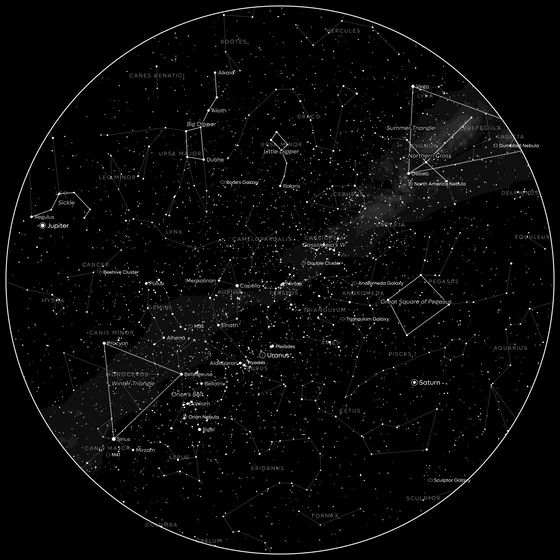
The band of light across a dark sky is our own galaxy, seen from inside. Its "disc" of stars is about 100,000 light-years across, but is very thin by comparison. It does not really have a sharp edge, so some surveys find stars positioned up to twice that width. We sit about 27,000 light-years from the centre, in a quiet stretch of one spiral arm.

Right now in our galaxy

The Sun's total speed around the centre of the Milky Way
247 km/s
Measured, with error
Time until Gaia Data Release 4
9.9 days
Measured
Confirmed exoplanets in the NASA Exoplanet Archive
6,473
Measured
updated 7 h ago

What the Milky Way is

The band in the sky is the galaxy

A galaxy is a great island of stars, gas and dust, held together by gravity. The Sun is just one star among them. Our galaxy is the Milky Way, and we live inside it, so we cannot see its shape. We see only a band.

The band is the disc, seen edge-on from within. Most stars lie in a flat layer, so when we look along the layer we see crowds of faint stars blurring into a glow. Look up or down, out of the layer, and there are far fewer. In the direction of the centre, clouds of dust and gas block visible light. NASA says the centre is "hidden from the prying eyes of optical telescopes". Infrared and radio waves pass through it.

The band is fading from many places. A 2016 atlas of night-sky brightness found that 35.9 per cent of the world's people lived where the Milky Way was no longer visible. That was the situation in 2014, and skies have brightened since.
The size of a disc

How wide, and how thin

The usual answer to the Milky Way's width is 100,000 light-years across. That number is a convention, not a strict border. The disc thins out gradually, with no outer wall, so its width depends on where you stop counting. Careful surveys have found stars much farther out, and a range of between 100,000 and 200,000 light-years is probably more honest. So we class it as debated.

The Milky Way disc is flat. Most of its stars lie in a layer about 1,000 light-years thick. The disc is about 100 times wider than it is thick.

The next big galaxy closest to the Milky Way is the Andromeda galaxy, and it lies 2.5 million light-years away. That is about 25 Milky Way widths.

The Sun's address

Where we are

We are about 27,000 light-years from the centre. The best figure comes from one star, S2, which swings round the black hole at the centre once every sixteen years. By tracking it with the European Southern Observatory's GRAVITY instrument, astronomers measured the distance to the centre to within about half a per cent. Other careful methods give slightly different answers.

Our own neighbourhood lies on the inner edge of the Local Arm. It was long called the Orion Spur, as if it were a small branch. Radio measurements of star-forming regions show it is a long arm segment in its own right, between the Sagittarius and Perseus arms. It is also where the Sun happens to be.

The black hole at the centre holds about four million Suns

26,990 lyThe Sun's distance from the centre of the Milky Way

Estimates, not a census

How many stars, and how we count them

Nobody has counted the stars of the Milky Way. Estimates run between 100 billion and 400 billion. The number comes from the galaxy's mass and from models of how many faint, small stars hide among the bright ones. We class it as debated.

The galaxy weighs 3.06 × 10⁴² kilograms, and most of that is dark matter, which we have never seen (about 1.5 trillion times the mass of the Sun). Estimates put the dark share of the mass at between 92 and 95 per cent, inside the virial radius, the edge of the halo we count. The mass is also debated, because the answer depends on how far out you count.

What we can do is map. ESA's Gaia telescope has measured 1.8 billion sources, most of them stars, in its third data release. That is only a small share of the galaxy's stars. The next release, Gaia Data Release 4, is due on 2 December 2026, in 9.9 days. Radio telescopes add the arms, by measuring the distances to young stars with a trick of angles called parallax. See mapping the stars.

between 100 billion and 400 billionStars in the Milky Way

A galactic year

One lap of the Sun

The Sun does not stand still. It circles the centre of the galaxy at 247 kilometres per second. Since you opened this page, it has carried you 0 kilometres around the galaxy. A full lap, one galactic year, takes 203 million years.

The Sun is 4.6 billion years old. That is about 22 laps. One lap ago, Earth was near the end of the Triassic Period. The Jurassic began 201 million years ago, close to the lap's date. Read more about the orbit of the sun here.

The speed is not exactly the circular speed of an imaginary orbit at our distance, 236 kilometres per second. The Sun also drifts a little relative to that orbit, and the total is the speed above.

203,000,000 yearsTime for the Sun to orbit the centre of the Milky Way once

Why it matters

Seen from inside

We have never seen the Milky Way from outside. Every picture of its spiral shape is a map, assembled from measurements made from inside. Even so, the numbers are firm enough to say where we are: inside the disc, a long way out from the centre.

The iron in your blood and the calcium in your bones were made in stars of this galaxy. See made of stars. The galaxy is vast, and we are part of it. The faint glow overhead holds every star you have ever seen.

When did you last look up to find the Milky Way band overhead?

Questions people ask

How big is the Milky Way?

The disc of stars is about 100,000 light-years across, though some surveys find disc stars out to twice that, so the real range is between 100,000 and 200,000 light-years. It is only about 1,000 light-years thick.

How many stars are in the Milky Way?

Nobody knows exactly. Estimates run between 100 billion and 400 billion. The galaxy has never been counted, only modelled from its mass and from the stars we can measure.

How far is Earth from the centre of the Milky Way?

about 27,000 light-years, measured from the orbit of the star S2 around the black hole at the centre. The uncertainty is roughly a hundred light-years either way.

How long does the Sun take to orbit the Milky Way?

One lap takes about 203 million years. The Sun travels at 247 kilometres per second, and has made about 22 laps since it formed.

How many planets are in the Milky Way?

We have confirmed 6,473 planets around other stars so far. That is a small part of the total, which we can only estimate. See how many planets are there beyond the Sun.

How do we know?

Every number on this page has a source

Show the 17 numbers and their sources
FactValueCertaintySourceAs of
Age of the Sun4,567,000,000 yearsMeasured, with errorScience
NASA Science
28 Oct 2026
Confirmed exoplanets in the NASA Exoplanet Archive6,473MeasuredNASA Exoplanet Science Institute (Caltech/IPAC)
NASA Exoplanet Science Institute (Caltech/IPAC)
NASA
NASA
22 Nov 2026, 06:00 UTC
Diameter of the Milky Way's disc of stars100,000 lyDebatedNASA
Astronomy & Astrophysics (via arXiv)
27 Oct 2026
Distance to Proxima Centauri4.2465 lyMeasured, with errorESA
Astronomy & Astrophysics
ESA
1 Jan 2016
Distance to the Andromeda galaxy2,480,000 lyMeasured, with errorThe Astrophysical Journal (via arXiv)
NASA Science
27 Oct 2026
Mass of the Milky Way, including its dark matter3.06 × 10⁴² kgDebatedThe Astrophysical Journal (via arXiv)
27 Oct 2026
Share of the Milky Way's mass, within its virial radius, that is dark matter94 percentEstimatedAnnual Review of Astronomy and Astrophysics (arXiv version)
11 Nov 2026
Share of the world's people living where light pollution hides the Milky Way35.9 percentEstimatedScience Advances
Science Advances
31 Dec 2014
Sources in the Gaia catalogue (Data Release 3)1.8 billionMeasuredESA Cosmos (Gaia)
ESA Science & Technology
13 Jun 2022
Speed of the Sun's orbit around the Milky Way236 km/sMeasured, with errorThe Astrophysical Journal
arXiv / The Astrophysical Journal
1 Nov 2019
Stars in the Milky Waybetween 100 billion and 400 billionDebatedESA
NASA
27 Oct 2026
The Sun's distance from the centre of the Milky Way26,990 lyMeasured, with errorAstronomy & Astrophysics (arXiv version)
Max Planck Institute for Extraterrestrial Physics
29 Jan 2021
The Sun's total speed around the centre of the Milky Way247 km/sMeasured, with errorThe Astrophysical Journal
1 Nov 2019
Thickness of the Milky Way's disc of stars1,000 lyEstimatedESA Science & Technology
NASA Science
11 Nov 2026
Time for the Sun to orbit the centre of the Milky Way once203,000,000 yearsMeasured, with errorarXiv / The Astrophysical Journal
NASA
1 Nov 2019
Time since the end of the Triassic and the start of the Jurassic201 million yearsMeasured, with errorInternational Commission on Stratigraphy
1 Dec 2024
Time until Gaia Data Release 49.9 daysMeasuredESA Cosmos (Gaia)
ESA Cosmos (Gaia)
11 Nov 2026